The Russian and American orientation towards the Arctic and its future prospects
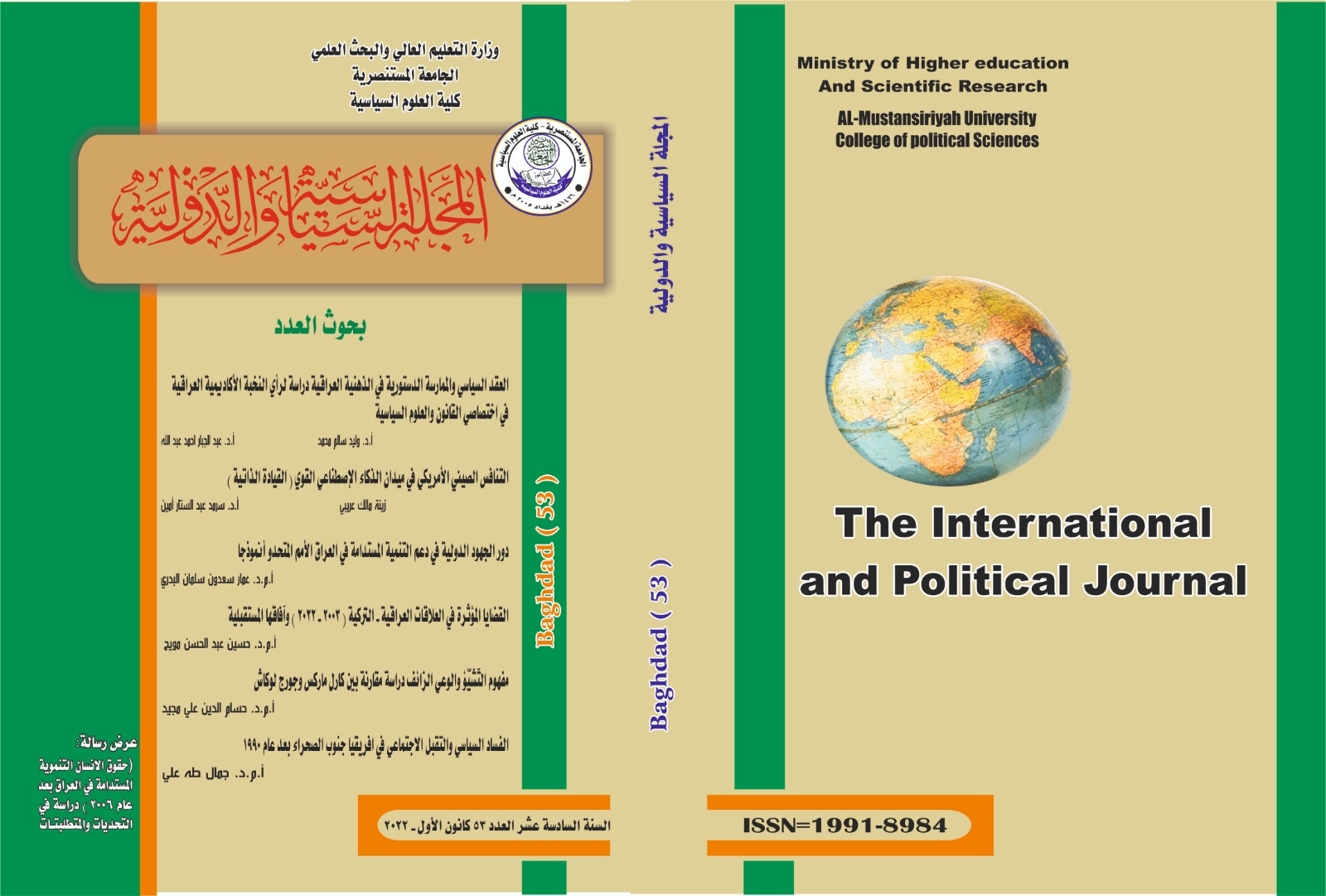
the international and political journal
Abstract
The Arctic is undergoing rapid transformations, making it one of the most important emerging geopolitical spaces in the contemporary international system. This is due to climate change, which has led to ice melt and the opening of new sea routes, as well as its vast natural resources. The study also addresses the geopolitical dimensions of the Arctic by analyzing its strategic geographical location, which connects three major continents, in addition to vital maritime routes such as the Northeast and Northwest Passages. These routes play a role in reshaping global trade maps and reducing time and economic costs, making the Arctic a focal point of strategic competition among major powers , The study examines the nature of Russian and American approaches to the Arctic.
The Russian Federation has adopted proactive policies based on strengthening its military presence and developing its infrastructure in the region, along with investing in natural resources and establishing a geopolitical reality that reinforces its control, leveraging its extensive Arctic coastline. In contrast, the United States has adopted a more balanced approach, combining security, economic, and political dimensions, with a focus on ensuring freedom of navigation, preventing unilateral hegemony, and strengthening cooperation with allies within an institutional framework , The study revealed that the Russian Federation is pursuing the militarization of the region and expanding its defensive and offensive capabilities, while the United States is working to contain this expansion by strengthening its military presence and intensifying coordination with its partners. Economically, the two countries compete to exploit resources and open new trade routes, while the political dimension is evident in each side's attempts to impose governance rules that align with its strategic interests.
The study concluded that the Arctic will remain an arena of strategic competition between the Russian Federation and the United States in the foreseeable future, and that the outcome of this competition will be determined by a combination of geopolitical, military, and economic factors, as well as the impact of climate change. It also suggested that the Russian Federation is likely to maintain relative control over the Arctic.
References
Mushairah. Asma Bin. 2019. "The Arctic in Russian Strategy: A New Space to Confront the Atlantic." Asian Issues Journal (1), Berlin.
Lan, Charles Emerson and Gladda. 2014. "Opening the Arctic: Realities and Challenges." Translated Studies 63. Emirates Center for Strategic Studies and Research.
Shug, Zaur. "The Polar Silk Road: The Struggle for the Arctic Region." Analytical Paper. Al Jazeera Center for Studies.
Taher, Ahmed. 2019. "Indicators of Russia's Return as a Great Power: Internal Foundations and Guarantees for Returning to the International Stage." Al Majalla Journal (179).
Al Buhay, Mona Ali. 2021. "The Arctic: A New Arena for International Competition." Strategic Horizons Journal (2). Abu Dhabi: 2021. 6. Bouziane. Naji. 2016. "The Strategy of Conflict in the Arctic." Lebanese National Defense Journal. (98).
Abdel-Aal, Ramadan. 2024. "The Russian Strategy in the Arctic." Opinion Article. Center for Arab-Eurasian Studies.
Bizard, Stephanie. et al. "Maintaining Arctic Cooperation in Russia." RAND Corporation. USA.
Rashed, Bassem. 2021. "Confronting Adversaries: US Military Options for Arctic Defense." Analytical Study. Al-Mustaqbal for Advanced Research and Studies.
Khalaf, Hala Salem. 2024. "Great Power Competition Strategies in the Arctic Region." Regional Studies Journal. (62).
Al-Saeed, Muhammad. "Who controls the Arctic's treasures between Washington. Moscow. and Beijing?" Al Jazeera Net. October 20. 2019. Available at: https://www.aljazeera.net/midan/reality/politics/2019/10/20/
The United States occupies Greenland and threatens Russia in the Arctic." RT Arabic. May 25. 2021. Available at: https://arabic.rt.com/press/1234801
Brynn, Amanda." "Geography and Overview of the Earth's Arctic Region." Eferrit. Available at: https://2u.pw/8G0wSv
Adly, Mariam." "The Ice Economy: Who Controls the Arctic's Wealth?" Wataninet. October 14. 2021. Available at: https://www.wataninet.com/2021/10/
Al-Mansi, Heba." "The Repercussions of Recession" US Policy Towards the Arctic. Al-Watan Al-Arabi Newspaper. May 27 2019. available at: https://zt.ms/14Pc
Al-Bali, Sufyan. The Battle for the Arctic: How the World's Powers Compete for "Frozen Treasures"? TRT Arabi. October 26 2021. available at: https://www.trtarabi.com/article/6963782
Dalal, Adel. Satellite Images Confirm Expansion of Russian Military Presence in the Arctic. Euronews Arabic. April 7 2021. available at: https://arabic.euronews.com/2021/04/07/satellite-images-expansion-of-russian-military-presence-in-arctic
Mansour, Muhammad. The Arctic is Concerned About Russia's Capabilities and Unable to Match Them. Al-Maydan Net. June 21. 2021. Link: https://www.almayadeen.net/butterfly-effect/1489491/
The Arctic: A region that arouses the ambitions of nations due to its potential wealth. Monte Carlo International. May 17 2021. Link: https://2u.pw/LucTbb
The Arctic: Seas. Ice. and Resources. Al Jazeera Net. March 2. 2018. Link: https://2u.pw/fdkh6lC
The struggle of the great powers melts the Arctic ice. Al Khaleej Newspaper. May 26. 2021. Link: https://www.alkhaleej.ae/2021-05-26/
Northwest Passage . Arctic Portal: Arctic News . 3/28/2026 . in link : https://arcticportal.org/shipping-portlet/shipping-routes/northwest-passage
Ahmed , Zahra. What is Transpolar Sea Route? .The Maritime Industry Guide . 28 August 2024 . in link : https://www.marineinsight.com/what-is-transpolar-sea-route/
Arctic Bridge . grokipedia . 3/28/2026 . in link : https://grokipedia.com/page/Arctic_Bridge
Northeast Passage Northern Sea Route (NSR) . Arctic Portal: Arctic News . 3/28/2026 . in link : https://arcticportal.org/shipping-portlet/shipping-routes/northeast-passage
Additional Files
Published
How to Cite
Issue
Section
License

This work is licensed under a Creative Commons Attribution 4.0 International License.
Journal Policies
All articles published in the International and Political Journal are licensed under a Creative Commons Attribution 4.0 International License. This means that the Authors can:
The journal allows reuse and remixing of content in accordance with a Creative Commons license.
Copy and redistribute the material in any medium or format.
Policy of publishing in The International and Political Journal
The journal is committed to the ethics of scientific publishing, and according to the publication ethics report of the journal.
The decision to publish is based on the value of the scientific research, to what extent it meets the conditions of publication approved, the declared policy of the journal, and its specialty.
It is based on the principles of the scientific honesty, and originality of research submitted for publication. It deals with the names of reviewers and their reports with great confidentiality.
The opinions published in the journal reflect the views of the authors, and not necessarily reflect the opinion of the editorial board.
The journal does not adhere to the publication of whatever comes to it. The time and place of publication are subject to technical considerations adopted in the editorial plan of the journal.
The journal does not abide to return the research papers to their owners whether accepted for publication or not.
The researcher is to be provided with the acceptance of publication within about 24 WEEKS. As for publication, the editorial board reserves its right in priority of publishing. The arrangement of the research papers in the same issue is subject to technical standards.
Diversify of publishing papers from solid universities and scientific centers from inside and outside Iraq is preferable.
The journal maintains hard copies and electronic archive of the published issues in addition to the publication of the research papers.
The journal also publishes the issues electronically through the website of the journal, and the official website of the Iraqi academic journals, and makes it possible to download. Thus, documenting the intellectual property of the research papers and publishing them internationally is achieved.
Terms of publication may be modified when necessary with no previous notice.
The researcher obtains a copy of his research paper. If he wishes to buy acopy of the journal, the volume costs ID 10000 from inside Iraq and $8from the outside.
The Editorial Board considers that the researcher who submits his research paper for publication in the journal has already read the terms and conditions of publication and agreed on them.
The journal publishes the research papers of the postgraduate students in special issues for this purpose.
Stages of editing and publishing:
The researcher undertakes that his research has never been published before, and has not been submitted for publication to other sides until the end of the evaluation procedures and the acceptance of publication in the journal.
The research papers submitted for publication are to subjected for preliminary examination by the editorial board to determine their suitability for the journal specialization, its policy and the safety of scientific research procedures, and then to indicate its eligibility for scientific evaluation. The editorial board may apologize for accepting the research all together or require the researcher to amend it in accordance with the journal policy before sending it to editors.
After conducting the scientific evaluation, the research paper returns back to the researcher to make the required amendments within a maximum of two weeks.
A copy of the final research paper is to be submitted to the secretariat of the journal a hard copy and a soft copy on a CD, in both Word and PDF format. The researcher is fully responsible for the typing and linguistic mistakes after submitting the full research paper on a CD.
Plagiarism checker
All research papers are subjected to Turnitin program to uncover plagiarism before being sent to scientific evaluation. The researcher undertakes a written pledge to take the legal and moral responsibility, in the event of the emergence of plagiarism or taking from the efforts of other researchers, without a reference to them. The journal uses appropriate anti-plagiarism software, such as Turnitin to check for plagiarism.
Dealing with Allegations of Research Misconduct
The Journal shall take reasonable and serious steps to identify and prevent the publication of papers where research misconduct has occurred, including plagiarism, citation manipulation, and data falsification/fabrication.
Scientific Evaluation:
Scientific evaluation strengthens the research paper submitted to the journal and helps to take the appropriate decision by the editorial board to publish it. It also benefits the researchers to improve and correct their research papers.
The research paper is sent to three evaluators in the same specialty to evaluate