Active Citizenship as a Mechanism for Achieving Societal Stability in Iraq: An Analytical Study in Light of Contemporary Political Thought
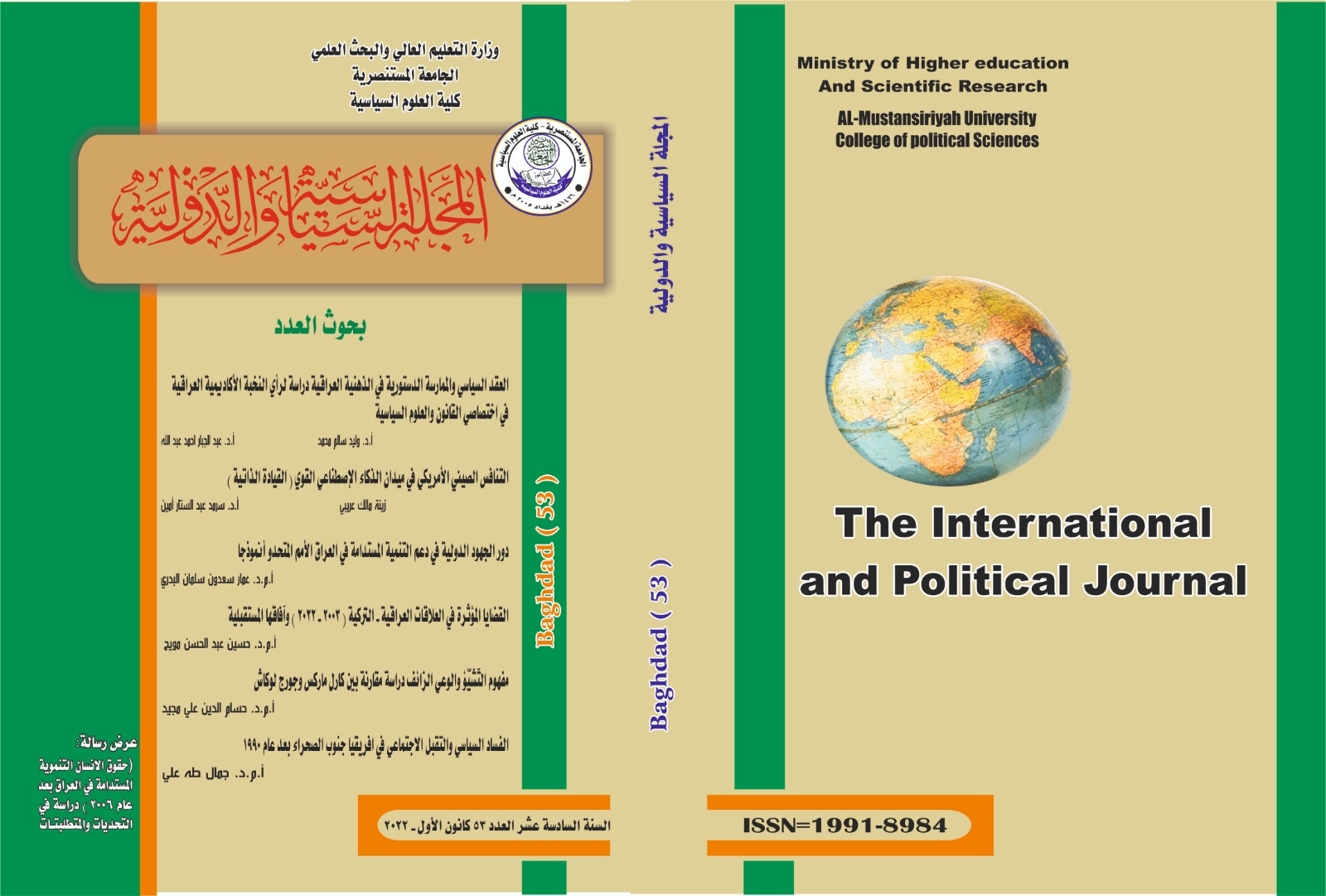
the international and political journal
Abstract
This study examines the role of active citizenship as a central mechanism for achieving societal stability in Iraq, in light of contemporary political thought. Iraq has suffered for decades from accumulated crises manifested in the fragility of the political structure, the spread of sectarian and ethnic conflicts, and weak trust between citizens and the state, which has negatively affected social cohesion. Accordingly, the study seeks to provide an analytical conception of active citizenship as an integrated framework that goes beyond mere legal rights towards active political and social participation and assuming responsibility for the public interest. The study adopts a critical analytical approach to deconstruct the problems of traditional citizenship, as well as a comparative approach to benefit from the experiences of some countries that succeeded in employing active citizenship to enhance stability. The study concludes that the absence of a culture of active citizenship is one of the most important causes of instability in Iraq, as weak community participation leads to the elite monopolizing
References
- Axel Honneth, The Social and Its Fragmented World: Socio-Philosophical Essays, translated by Yasser Al-Sarout, Turjuman Series, Arab Center for Research and Policy Studies, Doha, 2019.
- Axel Honneth, The Struggle for Recognition: The Moral Grammar of Social Conflicts, translated by Georges Katoura, Eastern Library, Beirut, 2015.
- Safd Abdul Aziz Hamadi Alawi, Citizenship and Its Role in Building the Modern Civil State: A Comparative Study, Dar Al-Kutub wa Al-Dirasat Al-Arabiya, Cairo, 2020.
- Mohamed Ali Sweilem, Transitional Justice: A Comparative Study, Egyptian Publishing and Distribution, Cairo, 2018.
- Yousef Mohamed Al-Kandari, Citizenship: History and Rooting, Center of Book for Publishing, Cairo, 2024.
- Atour Al-Mousawi, Transitional Justice in Iraq: Principles and Institutions, Al-Arif Publishing House, Beirut, 2023.
- Ali Saadi Abdul Zahra, Legislative Elections in Iraq for 2025: An Analytical Study, Al-Bayan Center for Studies and Planning, Baghdad, 2025.
- Faris Kamal Nazmi, Mazen Hatim, October 2019 Protests in Iraq from the Perspective of Participants: A Field Study in the Phenomenology of Resistance Protest Against State Violence, Al-Bayan Center for Studies and Planning, Baghdad, 2022.
- Majd Al-Din Khamash, Citizenship and National Identity in Jordan and the Arab World, Fadaat Publishing and Distribution, Amman, 2025.
- A group of researchers, The State and Society in Iraq: Reading the Present and Anticipating the Future, Dar Al-Rafidain for Printing, Publishing and Distribution, Beirut, 2016.
- Adian Mahdi Abdul Sahib, Sociology of Citizenship and Social Responsibility in Iraq, Ninār Journal for Humanities and Social Sciences, Issue 4, University of Hillah, Iraq, 2025.
- Osama Badr Abd, Electoral Systems in Iraq after 2003 – An Analytical Study, Journal of Social Sciences, Issue 35, Arab Democratic Center, Berlin, 2025.
- Hazim Sabah Ahmed, Civil Society Institutions and Their Role in Building the Modern State in Iraq, Tikrit University Journal for Humanities, Issue 3, University of Tikrit, Iraq, 2019.
- Hassan Karim Matar, Political Development in Iraq after 2003: Reality and Challenges, Al-Mustansiriya Journal for Arab and International Studies, Issue 90, Al-Mustansiriya University, Iraq, 2025.
- Raghad Naseef Jasim Al-Saraji, The Role of Citizenship in Building National Security: Iraq as a Model, Al-Mustansiriya Journal for Arab and International Studies, Issue 42, Al-Mustansiriya University, Iraq, 2013.
- Sura Hussein Khader, Popular Movements in Iraq after 2003: The October 2018 Movement as a Model, Al-Farahidi Arts Journal, Issue 50, University of Tikrit, Iraq, 2022.
- Abeer Siham Mahdi, The Theory of Recognition in Contemporary Western Political Thought: Axel Honneth and Nancy Fraser as Models, Tikrit Journal of Political Science, Issue 26, University of Tikrit, Iraq, 2021.
- Ala’a Abdul Hassan Jabr Al-Sailawi, The Experience of Transitional Justice in Iraq: Concept and Obstacles to Application, Al-Kufa Journal of Legal and Political Sciences, Issue 33, University of Kufa, Iraq, 2017.
- Emad Waka’ Ajil Al-Khafaji, Citizenship in Iraq after 2003: A Study of Causes and Challenges, Tikrit Journal of Political Science, Issue 8, University of Tikrit, Iraq, 2016.
- Mahmoud Salem Al-Samarrai, The Political Axis: Citizenship and Democracy, Regional Studies Journal, Issue 13, University of Mosul, Iraq, 2009.
- Mayada Ahmed Abdul Rahman Al-Jidda, Manifestations of Sectarianism in Iraq: A Sociological Vision, Lark Journal of Philosophy, Linguistics and Social Sciences, Issue 17, University of Wasit, Iraq, 2015.
- Yasser Ali Ibrahim Salama, State Building in Iraq: A Study of Challenges and Construction Strategies, Tikrit Journal of Political Science, Issue 25, University of Tikrit, Iraq, 2021.
- NIRIJ Network for Investigative Journalism, Academic and Civil Elites Launch the “Iraqis for Political and Social Reform” Initiative, 27 April 2025, available at: https://nirij.org/2025/04/27 /نخب-اكاديمية-ومدنية-تطلق-مبادرة-عراقي/ , accessed: 15 May 2026.
باشكين، أوريـت (Orit Bashkin). “Hybrid Nationalisms: Waṭanī and Qawmī Visions in Iraq under ʿAbd al-Karim Qasim, 1958–61.” International Journal of Middle East Studies 43. 2011: 29
Additional Files
Published
How to Cite
Issue
Section
License

This work is licensed under a Creative Commons Attribution 4.0 International License.
Journal Policies
All articles published in the International and Political Journal are licensed under a Creative Commons Attribution 4.0 International License. This means that the Authors can:
The journal allows reuse and remixing of content in accordance with a Creative Commons license.
Copy and redistribute the material in any medium or format.
Policy of publishing in The International and Political Journal
The journal is committed to the ethics of scientific publishing, and according to the publication ethics report of the journal.
The decision to publish is based on the value of the scientific research, to what extent it meets the conditions of publication approved, the declared policy of the journal, and its specialty.
It is based on the principles of the scientific honesty, and originality of research submitted for publication. It deals with the names of reviewers and their reports with great confidentiality.
The opinions published in the journal reflect the views of the authors, and not necessarily reflect the opinion of the editorial board.
The journal does not adhere to the publication of whatever comes to it. The time and place of publication are subject to technical considerations adopted in the editorial plan of the journal.
The journal does not abide to return the research papers to their owners whether accepted for publication or not.
The researcher is to be provided with the acceptance of publication within about 24 WEEKS. As for publication, the editorial board reserves its right in priority of publishing. The arrangement of the research papers in the same issue is subject to technical standards.
Diversify of publishing papers from solid universities and scientific centers from inside and outside Iraq is preferable.
The journal maintains hard copies and electronic archive of the published issues in addition to the publication of the research papers.
The journal also publishes the issues electronically through the website of the journal, and the official website of the Iraqi academic journals, and makes it possible to download. Thus, documenting the intellectual property of the research papers and publishing them internationally is achieved.
Terms of publication may be modified when necessary with no previous notice.
The researcher obtains a copy of his research paper. If he wishes to buy acopy of the journal, the volume costs ID 10000 from inside Iraq and $8from the outside.
The Editorial Board considers that the researcher who submits his research paper for publication in the journal has already read the terms and conditions of publication and agreed on them.
The journal publishes the research papers of the postgraduate students in special issues for this purpose.
Stages of editing and publishing:
The researcher undertakes that his research has never been published before, and has not been submitted for publication to other sides until the end of the evaluation procedures and the acceptance of publication in the journal.
The research papers submitted for publication are to subjected for preliminary examination by the editorial board to determine their suitability for the journal specialization, its policy and the safety of scientific research procedures, and then to indicate its eligibility for scientific evaluation. The editorial board may apologize for accepting the research all together or require the researcher to amend it in accordance with the journal policy before sending it to editors.
After conducting the scientific evaluation, the research paper returns back to the researcher to make the required amendments within a maximum of two weeks.
A copy of the final research paper is to be submitted to the secretariat of the journal a hard copy and a soft copy on a CD, in both Word and PDF format. The researcher is fully responsible for the typing and linguistic mistakes after submitting the full research paper on a CD.
Plagiarism checker
All research papers are subjected to Turnitin program to uncover plagiarism before being sent to scientific evaluation. The researcher undertakes a written pledge to take the legal and moral responsibility, in the event of the emergence of plagiarism or taking from the efforts of other researchers, without a reference to them. The journal uses appropriate anti-plagiarism software, such as Turnitin to check for plagiarism.
Dealing with Allegations of Research Misconduct
The Journal shall take reasonable and serious steps to identify and prevent the publication of papers where research misconduct has occurred, including plagiarism, citation manipulation, and data falsification/fabrication.
Scientific Evaluation:
Scientific evaluation strengthens the research paper submitted to the journal and helps to take the appropriate decision by the editorial board to publish it. It also benefits the researchers to improve and correct their research papers.
The research paper is sent to three evaluators in the same specialty to evaluate