Waterways War and Energy Security in The Middle East: A Study of Strategic Implications for Iraq
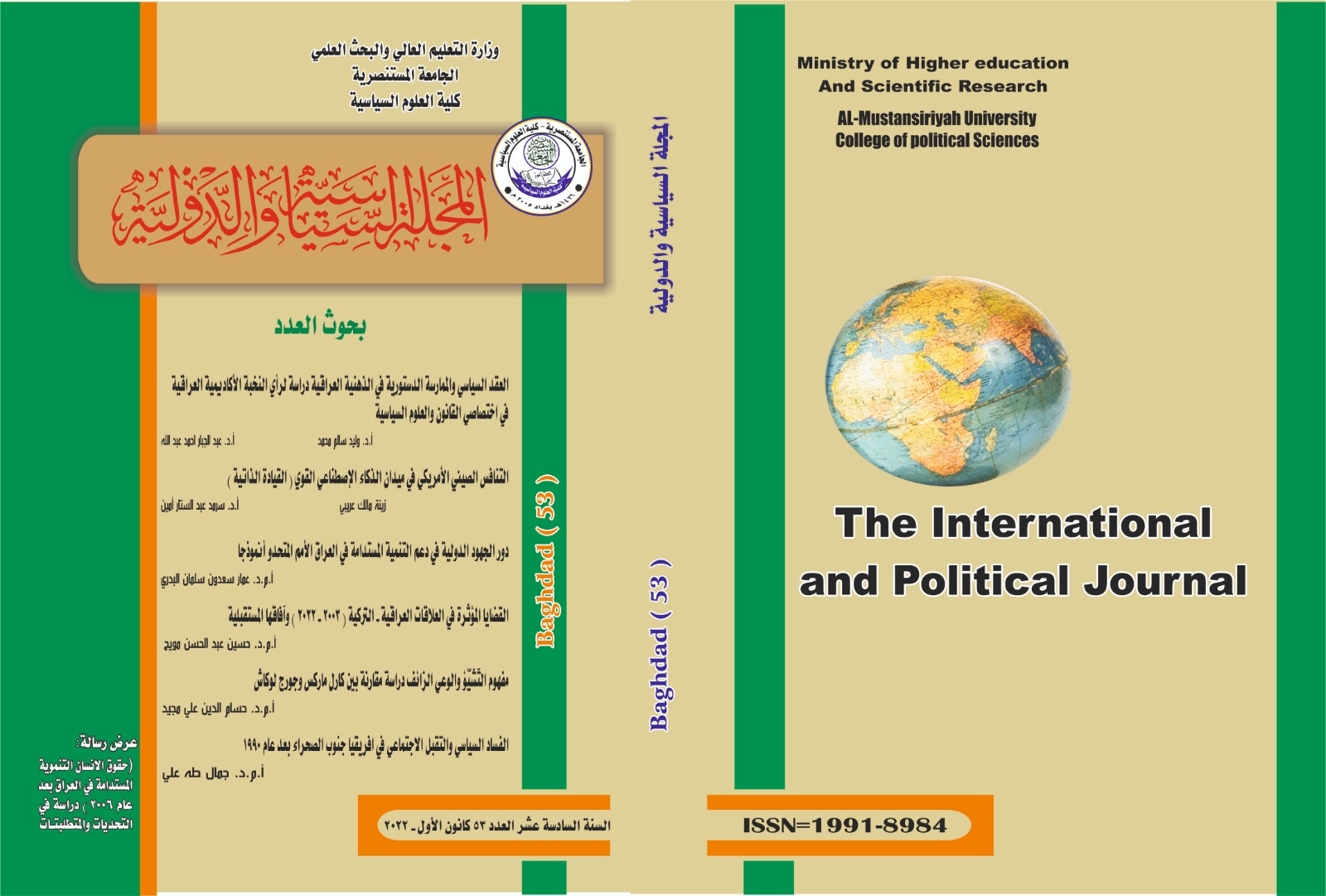
the international and political journal
Abstract
The waterways of the Middle East, specifically the Straits of Hormuz and Bab Al-Mandab, are vital geostrategic arteries that control the security of energy flows and supply chains globally. This research aims to analyze the dimensions of the emerging “waterway war” as a tool of conflict and mutual deterrence within the context of the direct and indirect military confrontation between the (American-Israeli) alliance and the Islamic Republic of Iran, focusing on the strategic and geo-economics repercussions for Iraq. The study's problem stems from a central question concerning the nature of contemporary security threats facing oil and gas supplies amidst this unprecedented regional escalation and its effects on the stability of the international economy and Iraqi energy security. The threat to freedom of navigation has shifted from a geopolitical constant to a variable subject to the equations of harsh mutual deterrence. To grasp the dimensions of this phenomenon, the research relies on deconstructing the maritime security dilemma, alongside analyzing potential
References
Abi-Aad, N. (2021). Petroleum pipeline security in the Middle East: Key takeaways. Issam Fares Institute for Public Policy and International Affairs, American University of Beirut.
Al-Samarraie, J. (2026, 5 5). Iraq offers massive oil discounts to offset Strait of Hormuz risks. Retrieved from IraqiNews.com: https://www.iraqinews.com/iraq/iraq-oil-discounts-basra-crude-2026/
Briney, A. (2025, April 29). [The Strait of Hormuz is a Chokepoint Between Persian]. Retrieved from thoughtco: https://www.thoughtco.com/strait-of-hormuz-1435398
Britannica, E. (2025, 8 15). Bab el-Mandeb Strait. Retrieved from In Encyclopaedia: https://www.britannica.com/place/Bab-El-Mandeb-Strait
EIA. (2025, 7 14). Iraq Country Analysis Brief. Retrieved from U.S. Energy Information Adhistration (EIA): https://www.eia.gov/international/content/analysis/countries_long/Iraq/Iraq_2025.pdf
exail. (2020). NAVAL MINES : AN INVISIBLE THREAT TO GLOBAL MARITIME SECURITY. Retrieved from exail: https://www.exail.com/resources/knowledge-center/naval-mines-invisible-sentinels
iea. (2026, 5). Oil Market Report - May 2026. Retrieved from iea: https://www.iea.org/reports/oil-market-report-may-2026
Mahmoudi, S. (2018, 9 1). A survey of the Strategic Importance of the Strait of Hormuz in the Middle East, with an Emphasis on Iran's Role in Maintaining its Security. International Journal of Political Science, p. 72.
researchdive. (2024, 1). Sea Skimmer Missile Market Report. Retrieved from researchdive: https://www.researchdive.com/9178/sea-skimmer-missile-market
Şeker, B. (2024). Don't Forget About the Red Sea. he Cairo Review of Global Affairs.
World Atlas. (2015, 2 23). Where Is The Bab El-Mandeb Strait? Retrieved from World Atlas: https://www.worldatlas.com/articles/where-is-the-bab-el-mandeb-strait.html
World Economic Forum. (2026, 4 9). How war in the Middle East is turning governments into insurers of last resort. Retrieved from World Economic Forum: https://www.weforum.org/stories/2026/04/how-middle-east-war-turning-governments-into-insurers-last-resort/
world statistics network. (2026). Strait of Hormuz Importance Statistics 2026: key facts. Retrieved from the global Statistics: https://theglobalStatistics.com
Additional Files
Published
How to Cite
Issue
Section
License

This work is licensed under a Creative Commons Attribution 4.0 International License.
Journal Policies
All articles published in the International and Political Journal are licensed under a Creative Commons Attribution 4.0 International License. This means that the Authors can:
The journal allows reuse and remixing of content in accordance with a Creative Commons license.
Copy and redistribute the material in any medium or format.
Policy of publishing in The International and Political Journal
The journal is committed to the ethics of scientific publishing, and according to the publication ethics report of the journal.
The decision to publish is based on the value of the scientific research, to what extent it meets the conditions of publication approved, the declared policy of the journal, and its specialty.
It is based on the principles of the scientific honesty, and originality of research submitted for publication. It deals with the names of reviewers and their reports with great confidentiality.
The opinions published in the journal reflect the views of the authors, and not necessarily reflect the opinion of the editorial board.
The journal does not adhere to the publication of whatever comes to it. The time and place of publication are subject to technical considerations adopted in the editorial plan of the journal.
The journal does not abide to return the research papers to their owners whether accepted for publication or not.
The researcher is to be provided with the acceptance of publication within about 24 WEEKS. As for publication, the editorial board reserves its right in priority of publishing. The arrangement of the research papers in the same issue is subject to technical standards.
Diversify of publishing papers from solid universities and scientific centers from inside and outside Iraq is preferable.
The journal maintains hard copies and electronic archive of the published issues in addition to the publication of the research papers.
The journal also publishes the issues electronically through the website of the journal, and the official website of the Iraqi academic journals, and makes it possible to download. Thus, documenting the intellectual property of the research papers and publishing them internationally is achieved.
Terms of publication may be modified when necessary with no previous notice.
The researcher obtains a copy of his research paper. If he wishes to buy acopy of the journal, the volume costs ID 10000 from inside Iraq and $8from the outside.
The Editorial Board considers that the researcher who submits his research paper for publication in the journal has already read the terms and conditions of publication and agreed on them.
The journal publishes the research papers of the postgraduate students in special issues for this purpose.
Stages of editing and publishing:
The researcher undertakes that his research has never been published before, and has not been submitted for publication to other sides until the end of the evaluation procedures and the acceptance of publication in the journal.
The research papers submitted for publication are to subjected for preliminary examination by the editorial board to determine their suitability for the journal specialization, its policy and the safety of scientific research procedures, and then to indicate its eligibility for scientific evaluation. The editorial board may apologize for accepting the research all together or require the researcher to amend it in accordance with the journal policy before sending it to editors.
After conducting the scientific evaluation, the research paper returns back to the researcher to make the required amendments within a maximum of two weeks.
A copy of the final research paper is to be submitted to the secretariat of the journal a hard copy and a soft copy on a CD, in both Word and PDF format. The researcher is fully responsible for the typing and linguistic mistakes after submitting the full research paper on a CD.
Plagiarism checker
All research papers are subjected to Turnitin program to uncover plagiarism before being sent to scientific evaluation. The researcher undertakes a written pledge to take the legal and moral responsibility, in the event of the emergence of plagiarism or taking from the efforts of other researchers, without a reference to them. The journal uses appropriate anti-plagiarism software, such as Turnitin to check for plagiarism.
Dealing with Allegations of Research Misconduct
The Journal shall take reasonable and serious steps to identify and prevent the publication of papers where research misconduct has occurred, including plagiarism, citation manipulation, and data falsification/fabrication.
Scientific Evaluation:
Scientific evaluation strengthens the research paper submitted to the journal and helps to take the appropriate decision by the editorial board to publish it. It also benefits the researchers to improve and correct their research papers.
The research paper is sent to three evaluators in the same specialty to evaluate