The Food Security Crisis in Fragile States: Iraq as a Case Study
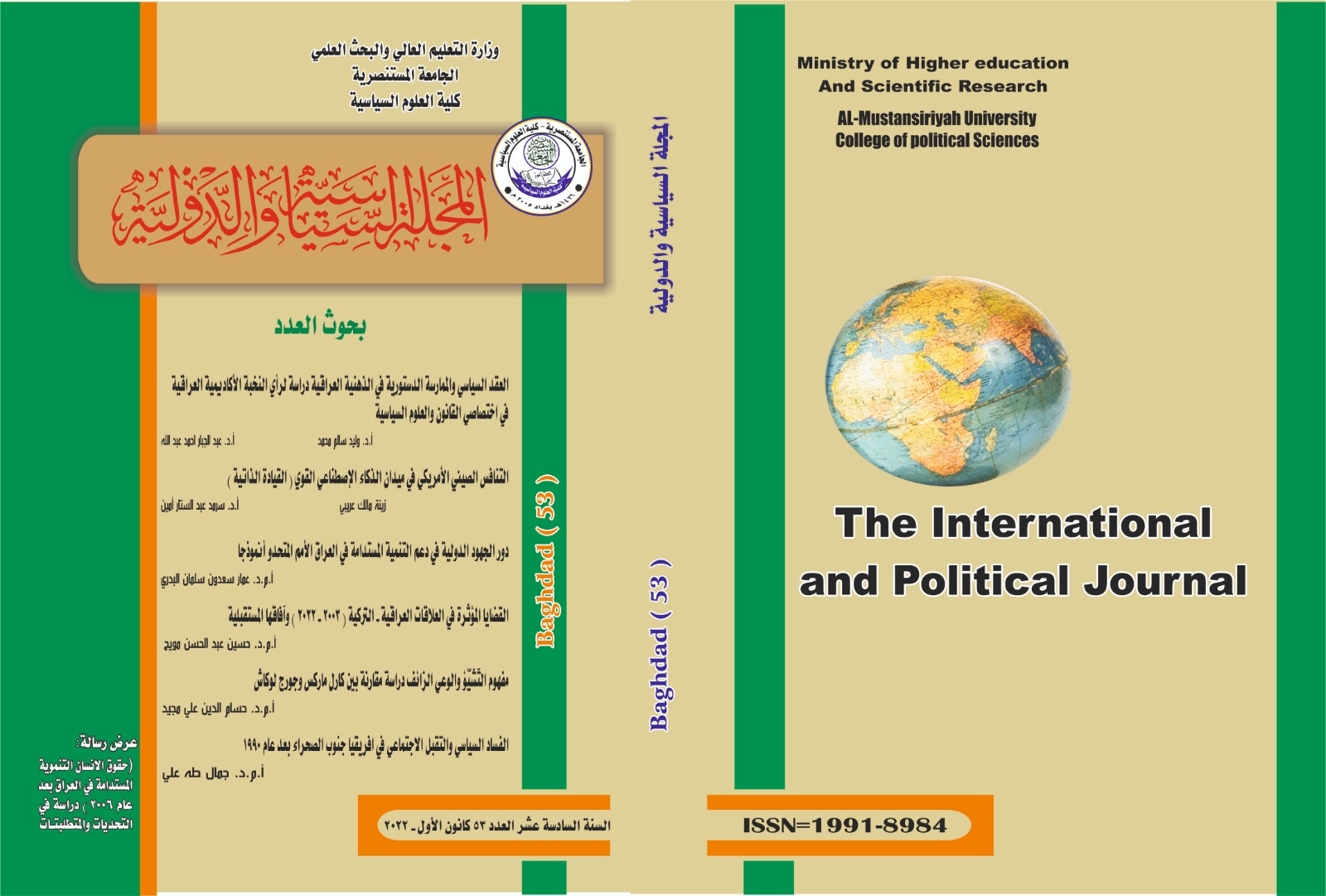
the international and political journal
Abstract
This study examines the food security crisis in fragile states, taking Iraq as a case study, by analyzing the relationship between weak state institutions, fluctuating public policies, and the challenges of achieving food security. The study proceeds from the premise that food security constitutes a component of national security and is closely linked to the state’s capacity to manage its resources, enhance domestic production, and respond to internal and external shocks.
The study adopts the descriptive-analytical method and the case study approach. It focuses on the impact of weak governance, dependence on a rentier economy, environmental and water-related challenges, and disruptions in international markets and supply chains on the deepening of Iraq’s food security crisis. The study concludes that the fragility of state institutions has contributed to the decline of domestic production and the expansion of dependence on imports, making Iraq more vulnerable to external shocks. It also concludes that addressing this crisis requires strengthening institutional efficiency, developing public policies, supporting domestic production, and diversifying the economy in order to achieve more sustainable food security.
References
Abdel-Ghani, Mohamed Fathy. 2020. "The Evolution of the Concept of Sustainable Development, Its Dimensions, and Its Outcomes." “Scientific Journal of Economics and Trade ”. no. 37.
Al-Tarawneh, Rawan Ibrahim. International Conflicts and Their Role in Political Stability, Economic Growth, and Arab Political Systems . Amman: Dar Al-Khaleej for Publishing and Distribution.
Sabahi, Ali Shehab Ahmed. 2019. Private Foreign Investment: Reality and Prospects, A Comparative Legal Study. Beirut: Dar Al-Akademiyoun for Publishing and Distribution.
Abdelkader, Motai. 2014. 'Food Security in the Arab World: When and How Will It Be Achieved'. New Economics Journal, no. 10. Algeria: University of Chlef.
Zuhdi, Tamara Muhammad. 2021. "The Impact of Applying Good Governance Rules on Sustainable Development Indicators in West Bank Municipalities: Ramallah as a Model." Master's thesis, Palestine: Al-Quds University
Mustafa, Saif Abdullah, and Salem Mustafa Al-Najafi. 2013. "The Impact of Income Levels on Per Capita Food Share and Food Deficit in Arab Countries: Selected Years." Tanmiat Al-Rafidain . no. 35.
Mubarak, Farah Diaa. 2015. "Poverty Injustice and Terrorism". Article published in Political Issues, University of Baghdad, no. 77 (2023).
Abdel Khaleq, Gouda. Arab Food Security: The Food and Oil Dilemma. Beirut: Arab Center for Research and Policy Studies.
News, Twilight. Iraqi minister of trade: the strategic wheat stock is enough for 23 days and we are waiting for marketing. Twilight news agency, 9/3/2022. On the link: https://shafaq.com/ar/
(FAO). 2022. Report of the food and Agriculture Organization of the United Nations. The impact of the war in Ukraine on World Food Markets and food security. Rome.
The range newspaper. Food security in Iraq.. The crisis exposes the slogans of abundance and reveals the truth of self-sufficiency. Issue (6144) twenty - third year-Monday, May 11, 2026.
Nader, Yasser Talal. "Public policies for food security after the corona pandemic, Iraq is a model". Journal of political issues. Issue 77, 2024. Iraq.
Hejaz, Ziad Khalil. 2009. Water security and Arab food security. Beirut: Arab renaissance House.
Abdul Hayali, Abdul Amir Abbas. Hamid, Hussein Abdul Majid. "The role of food in the international system: a case study of Iraq as a model". Journal of legal and Political Sciences. University of Diyala. Volume 9. Issue 1. 2020.
Abdelkader, Ashraf. And others. 2013. Economic growth and sustainable development in the Arab countries ;development policies and employment country studies. Beirut. 1 SE ED. Volume 1. Arab Center for research and Policy Studies.
Abdelkhalek, Gouda. 2015.Arab food security: the duality of food and oil. Arab Center for research and Policy Studies. Beirut.
Al-saraiti, Mr. Mohammed Ahmed. 2000. Food security and economic development (Islamic Vision: an applied study on some Arab countries). The new University Publishing House. Alexandria.
Saud, Zia Hussein. 2015. The role of funding sources in the development of infrastructure projects for selected countries with special reference to Iraq. Unpublished master's thesis. Faculty of management and economics. University of Baghdad.
Al-Luzi, Salim Abdul Karim. Et al. 2008. The challenges of Arab food security. Lebanon. Arab Foundation for studies and publishing.
Food and Agriculture Organization of the United Nations. Conference on new challenges "climate change energy and food" Rome. 2005. View it on 23/2/2022 on the website: www.fao.org/foodclimote
Food and Agriculture Organization of the United Nations. 2016. The state of food and agriculture: climate change, agriculture and food security. Rome.
The first ESCWA report on Water Development. 2005. The region is severely affected by socio-economic drought. United Nations. New York.
Haddad, Hamid Abd. 2012. "Iraq's water security challenges" is an International Studies journal. University of Baghdad. Issue 51.
Badri, by the name of Hazem. 2010. "The impact of scarce water resources on irrigated agriculture in Iraq". Journal of management and economics. Mustansiriya University. Issue 80.
The World Bank. 1997. Development Report. Translation: Arabic translation unit at the World Bank. Washington.
Transparency International. "Annual report of the Corruption Perceptions Index" for the years (1995-2014).
Hussain, Adnan Naama. The water crisis and its impact on agricultural development. Center for Desert Studies-Department of desert geology, article published on 7/ 1 / 2024, at the link: https://desertstudiescenter.uoanbar.edu.iq/News_Details.php?ID=433
Additional Files
Published
How to Cite
Issue
Section
License

This work is licensed under a Creative Commons Attribution 4.0 International License.
Journal Policies
All articles published in the International and Political Journal are licensed under a Creative Commons Attribution 4.0 International License. This means that the Authors can:
The journal allows reuse and remixing of content in accordance with a Creative Commons license.
Copy and redistribute the material in any medium or format.
Policy of publishing in The International and Political Journal
The journal is committed to the ethics of scientific publishing, and according to the publication ethics report of the journal.
The decision to publish is based on the value of the scientific research, to what extent it meets the conditions of publication approved, the declared policy of the journal, and its specialty.
It is based on the principles of the scientific honesty, and originality of research submitted for publication. It deals with the names of reviewers and their reports with great confidentiality.
The opinions published in the journal reflect the views of the authors, and not necessarily reflect the opinion of the editorial board.
The journal does not adhere to the publication of whatever comes to it. The time and place of publication are subject to technical considerations adopted in the editorial plan of the journal.
The journal does not abide to return the research papers to their owners whether accepted for publication or not.
The researcher is to be provided with the acceptance of publication within about 24 WEEKS. As for publication, the editorial board reserves its right in priority of publishing. The arrangement of the research papers in the same issue is subject to technical standards.
Diversify of publishing papers from solid universities and scientific centers from inside and outside Iraq is preferable.
The journal maintains hard copies and electronic archive of the published issues in addition to the publication of the research papers.
The journal also publishes the issues electronically through the website of the journal, and the official website of the Iraqi academic journals, and makes it possible to download. Thus, documenting the intellectual property of the research papers and publishing them internationally is achieved.
Terms of publication may be modified when necessary with no previous notice.
The researcher obtains a copy of his research paper. If he wishes to buy acopy of the journal, the volume costs ID 10000 from inside Iraq and $8from the outside.
The Editorial Board considers that the researcher who submits his research paper for publication in the journal has already read the terms and conditions of publication and agreed on them.
The journal publishes the research papers of the postgraduate students in special issues for this purpose.
Stages of editing and publishing:
The researcher undertakes that his research has never been published before, and has not been submitted for publication to other sides until the end of the evaluation procedures and the acceptance of publication in the journal.
The research papers submitted for publication are to subjected for preliminary examination by the editorial board to determine their suitability for the journal specialization, its policy and the safety of scientific research procedures, and then to indicate its eligibility for scientific evaluation. The editorial board may apologize for accepting the research all together or require the researcher to amend it in accordance with the journal policy before sending it to editors.
After conducting the scientific evaluation, the research paper returns back to the researcher to make the required amendments within a maximum of two weeks.
A copy of the final research paper is to be submitted to the secretariat of the journal a hard copy and a soft copy on a CD, in both Word and PDF format. The researcher is fully responsible for the typing and linguistic mistakes after submitting the full research paper on a CD.
Plagiarism checker
All research papers are subjected to Turnitin program to uncover plagiarism before being sent to scientific evaluation. The researcher undertakes a written pledge to take the legal and moral responsibility, in the event of the emergence of plagiarism or taking from the efforts of other researchers, without a reference to them. The journal uses appropriate anti-plagiarism software, such as Turnitin to check for plagiarism.
Dealing with Allegations of Research Misconduct
The Journal shall take reasonable and serious steps to identify and prevent the publication of papers where research misconduct has occurred, including plagiarism, citation manipulation, and data falsification/fabrication.
Scientific Evaluation:
Scientific evaluation strengthens the research paper submitted to the journal and helps to take the appropriate decision by the editorial board to publish it. It also benefits the researchers to improve and correct their research papers.
The research paper is sent to three evaluators in the same specialty to evaluate