The reality of child labor in Iraq after 2003 and its impact on hindering sustainable development
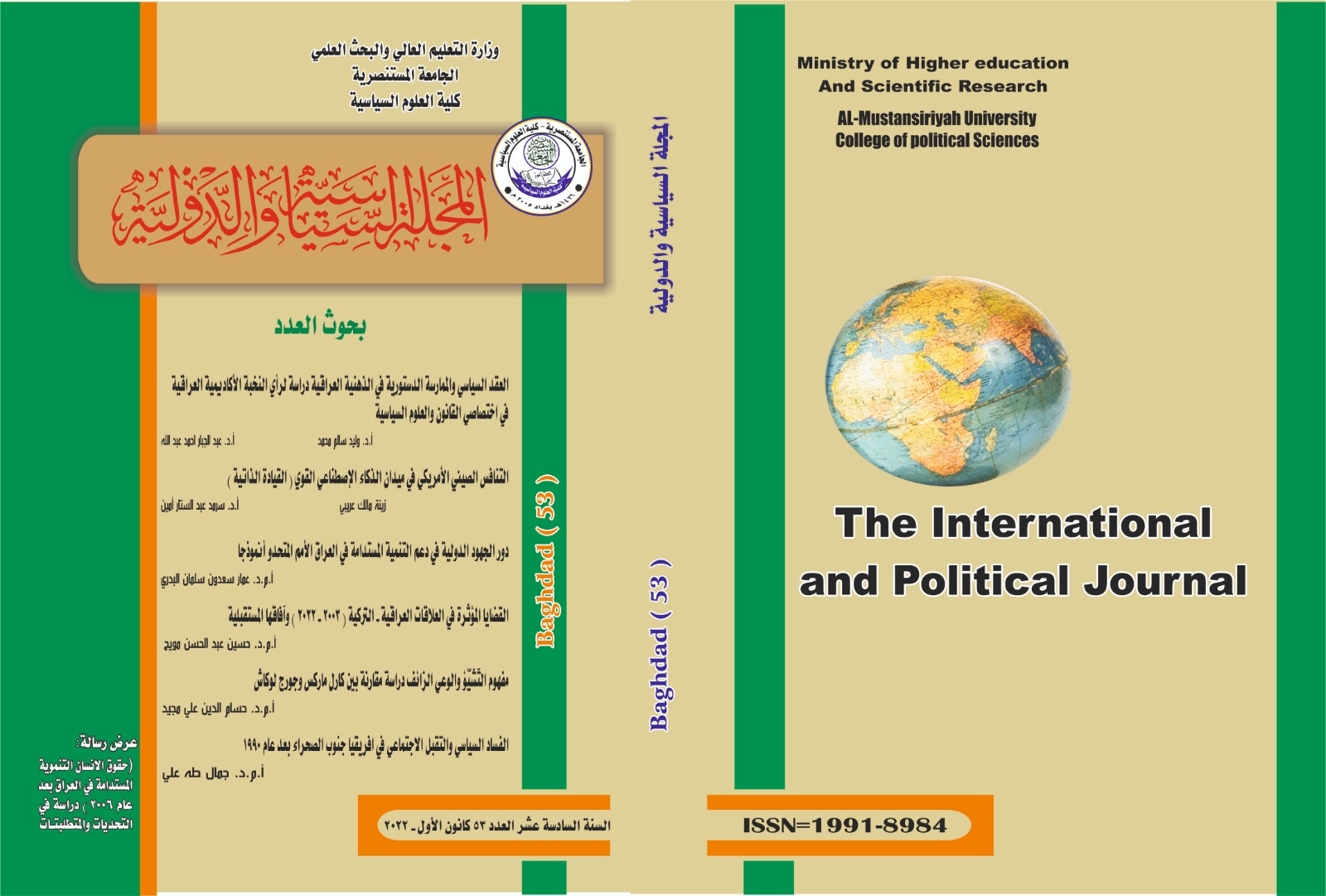
the international and political journal
Abstract
Iraq has witnessed several waves of armed conflicts and population displacement in recent years, which were expected to trigger new waves of child labor, the extent of which and its severity still need to be comprehensively measured.
This fact has been added to the already existing social problems in the region, both in rural and urban areas, stemming from the fragility of the economy, the lack of educational opportunities, and favorable social norms and standards. This expected increase in child labor comes amid global efforts to eliminate this dangerous phenomenon, and in light of the remarkable efforts made by the Iraqi government to align its national legal and institutional frameworks with international standards related to this phenomenon.
References
Mohamed Gamal Mohamed El-Nabiti, "Economic Characteristics and the Daily Journey of Child Labor in Khanka Center, Egypt," *Arab Journal of Geographical Studies*, Vol. 7, No. 21, 2024.
Warda Ben Moussa, "Economic Exploitation of Children, Egypt," *Journal of Legal and Political Research and Studies*, Faculty of Law and Political Science, University of Blida, No. 12, 2017.
Shahrazad Boujemaa, "Child Labor: Between Need and Exploitation," Faculty of Law and Political Science, University of Blida 2, Algeria, *Annals of the University of Algiers 1*, Vol. 35, No. 1, 2020.
Article 1 of the United Nations Convention on the Rights of the Child, dated December 20, 1989, which entered into force in 1990.
Article 1 of the Optional Protocol to the Convention on the Rights of the Child on the involvement of children in armed conflict, dated May 25, 2000, which entered into force on February 23, 2002.
Ahmed Zaki Badawi, Dictionary of Social Science Terms, Lebanon, n.d., 1982.
Child Welfare Authority in Iraq, Rapid Assessment of the Worst Forms of Child Labor, December 2015.
Kawthar Abdul Hamid Saeed, Child Labor and Social Policies in Iraq, First Annual Scientific Conference on Social Studies, House of Wisdom, 2011
Nadia Abdul Hadi Sawadi, Children's Rights in Iraq after 2003, Unpublished Master's Thesis, College of Political Science, University of Baghdad, 2013. 10.
Hussein Mohammed Al-Faihan, Child Labor in Iraq... Causes and Solutions, International Internet, at the following link: www.lna.lq, accessed 15/2/2026, 8:30 AM
Muzaffar Husni Ali: The Phenomenon of Child Labor in Iraq: Causes and Consequences, Iraqi Journal of Economic Sciences, Issue (15), 2007.
Abdul Wahid Mashal, Unemployment and Behavioral Deviance in Iraqi Society, Bayt al-Hikma, Journal of Social Studies, Issue 25, 2011.
Constitution of the Republic of Iraq of 2005.
Layla Badiwi Khudair, Child Labor: Is There a Limit to Its Growth in Iraq?, Iraqi Economists Network, Policy Papers on Child Labor, 2020.
Labor Law No. 37 of 2015, Collection of Iraqi Laws, compiled by Judge Nabil Abdul Rahman Hayawi, Beirut, Al-Atik Books, 2017.
Rabiha Nabar, Child Labor: Causes and Consequences, Algeria, Journal of Human and Social Sciences, Vol. 8, No. 4, 2019.
Tayseer Abdullah and Rashid Arar, Causes and Dimensions of the Phenomenon of Child Labor in Jerusalem, Palestine - Al-Quds University, Journal of Psychological and Educational Sciences, January 6, 2020.
Asma Abbas Aziz Al-Dulaimi and Ahmed Ibrahim Ali Ahmed, Child Labor and its Causes in Diyala Governorate: An Analytical Study, Journal of the College of Education, Vol. 1, No. 57.
Fatima Kharshaf, Causes and Dimensions of Child Labor, University of Algiers 3, Ma'alim Journal for Media and Communication Studies, Vol. 1, No. 2, 2020.
Wafaa Marzouq, Protecting Children's Rights under the International Convention, Beirut, Al-Halabi Legal Publications, 2010.
Jamal Muhammad Ali Al-Jawahiri et al., Rapid Assessment of the Worst Forms of Child Labor – Iraq, December 2015, p. 75.
Jamila Khaydar and Muhammad Hassian, The Reality of Child Labor in Algeria, Algeria, Al-Murabba Magazine, Issue 22, 2019.
Adel Mahmoud Al-Rifai and Dhahi Hamdan Al-Rifai, Poverty, Slums, and Political Participation, Egypt, Dar Al-Manar for Publishing and Distribution, 2015.
24. Adnan Abdul-Amir Mahdi Al-Zubaidi, Child Labor in Iraq After 2003: Reality and Solutions, Baghdad, Al-Nahrain University, College of Political Science, Political Issues Journal, Issue 72, 2023.
Lama Karim Khudair, Violation of Children's Rights and the Perspective of Current Iraqi Laws and Legislation, Journal of the College of Law and Political Science, Issue 30, October 2025.
Additional Files
Published
How to Cite
Issue
Section
License

This work is licensed under a Creative Commons Attribution 4.0 International License.
Journal Policies
All articles published in the International and Political Journal are licensed under a Creative Commons Attribution 4.0 International License. This means that the Authors can:
The journal allows reuse and remixing of content in accordance with a Creative Commons license.
Copy and redistribute the material in any medium or format.
Policy of publishing in The International and Political Journal
The journal is committed to the ethics of scientific publishing, and according to the publication ethics report of the journal.
The decision to publish is based on the value of the scientific research, to what extent it meets the conditions of publication approved, the declared policy of the journal, and its specialty.
It is based on the principles of the scientific honesty, and originality of research submitted for publication. It deals with the names of reviewers and their reports with great confidentiality.
The opinions published in the journal reflect the views of the authors, and not necessarily reflect the opinion of the editorial board.
The journal does not adhere to the publication of whatever comes to it. The time and place of publication are subject to technical considerations adopted in the editorial plan of the journal.
The journal does not abide to return the research papers to their owners whether accepted for publication or not.
The researcher is to be provided with the acceptance of publication within about 24 WEEKS. As for publication, the editorial board reserves its right in priority of publishing. The arrangement of the research papers in the same issue is subject to technical standards.
Diversify of publishing papers from solid universities and scientific centers from inside and outside Iraq is preferable.
The journal maintains hard copies and electronic archive of the published issues in addition to the publication of the research papers.
The journal also publishes the issues electronically through the website of the journal, and the official website of the Iraqi academic journals, and makes it possible to download. Thus, documenting the intellectual property of the research papers and publishing them internationally is achieved.
Terms of publication may be modified when necessary with no previous notice.
The researcher obtains a copy of his research paper. If he wishes to buy acopy of the journal, the volume costs ID 10000 from inside Iraq and $8from the outside.
The Editorial Board considers that the researcher who submits his research paper for publication in the journal has already read the terms and conditions of publication and agreed on them.
The journal publishes the research papers of the postgraduate students in special issues for this purpose.
Stages of editing and publishing:
The researcher undertakes that his research has never been published before, and has not been submitted for publication to other sides until the end of the evaluation procedures and the acceptance of publication in the journal.
The research papers submitted for publication are to subjected for preliminary examination by the editorial board to determine their suitability for the journal specialization, its policy and the safety of scientific research procedures, and then to indicate its eligibility for scientific evaluation. The editorial board may apologize for accepting the research all together or require the researcher to amend it in accordance with the journal policy before sending it to editors.
After conducting the scientific evaluation, the research paper returns back to the researcher to make the required amendments within a maximum of two weeks.
A copy of the final research paper is to be submitted to the secretariat of the journal a hard copy and a soft copy on a CD, in both Word and PDF format. The researcher is fully responsible for the typing and linguistic mistakes after submitting the full research paper on a CD.
Plagiarism checker
All research papers are subjected to Turnitin program to uncover plagiarism before being sent to scientific evaluation. The researcher undertakes a written pledge to take the legal and moral responsibility, in the event of the emergence of plagiarism or taking from the efforts of other researchers, without a reference to them. The journal uses appropriate anti-plagiarism software, such as Turnitin to check for plagiarism.
Dealing with Allegations of Research Misconduct
The Journal shall take reasonable and serious steps to identify and prevent the publication of papers where research misconduct has occurred, including plagiarism, citation manipulation, and data falsification/fabrication.
Scientific Evaluation:
Scientific evaluation strengthens the research paper submitted to the journal and helps to take the appropriate decision by the editorial board to publish it. It also benefits the researchers to improve and correct their research papers.
The research paper is sent to three evaluators in the same specialty to evaluate