Turkey's Smart Power Policy Towards Neighboring Arab States After 2012: Syria and Iraq as Case Studies
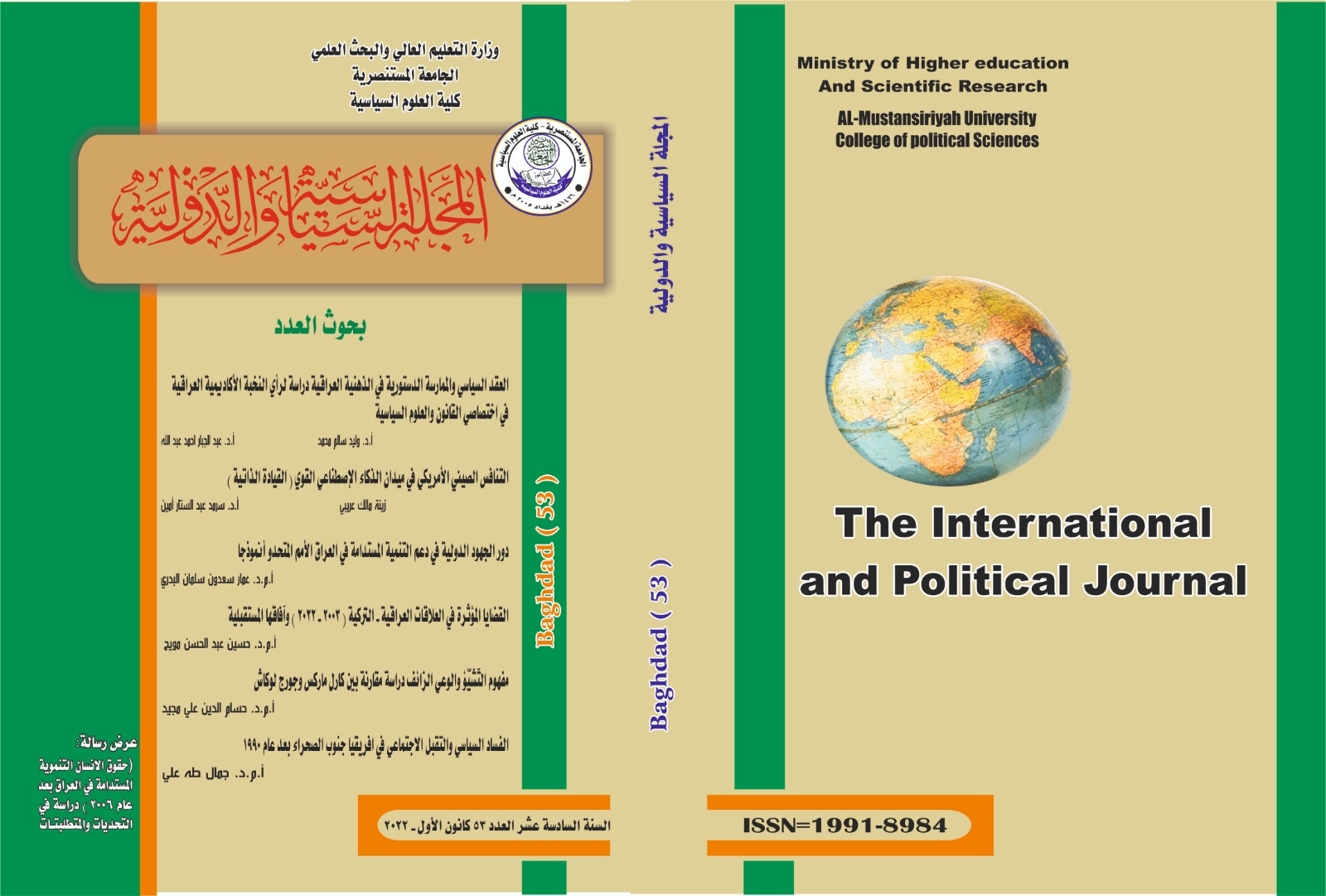
the international and political journal
Abstract
This research addressed the description and analysis of the smart power policy adopted and practiced by Turkey toward its Arab neighboring countries after 2012, with a particular focus on the cases of Syria and Iraq as border states and strategic depth states for Turkey. It examines how political, economic, and cultural tools, as well as military and security means, were employed to achieve Turkish strategic interests. It also highlights the transformations that occurred in Turkish foreign policy as a result of regional changes and security challenges witnessed in the region, and the impact of all this on regional balances.
Keywords: Smart power, Turkey, Iraq, Syria
References
• Abu Mustafa, Mohammed Suleiman Mahmoud. Turkish Soft Power in the Middle East. Palestine: Mediterranean Center for Strategic Studies, Al-Aqsa University, March 2024.
• Al-Hassan, Ammar Mar‘i. The Future of Turkey's Geostrategic Position in International Conflict: A Study of the Variables of the International and Regional Environment. Lebanon: Dar Al-Sanhouri, 2018.
• Nye, Joseph S. *The Paradox of American Power*. Translated by Mohammed Tawfiq Al-Bajirmi. Obeikan Library, Riyadh, 2003.
• Suleiman, Yumna. Smart Power: Concept and Dimensions, A Foundational Study. Cairo: Egyptian Institute for Political and Strategic Studies, January 2016.
• Abdulhay, Samah Abdel-Sabour. Smart Power in Foreign Policy. Egypt: Dar Al-Bashir for Culture and Science, 2014.
Theses and Dissertations
• Al-Oqeibi, Adel Ali Suleiman. The Concept of Power in International Relations, 1991–2017 (The American Perspective: A Case Study). Unpublished Master's Thesis, Faculty of Arts and Sciences, Middle East University, Jordan, 2018.
• Al-Kaoud, Iyad Khalaf Omar. The Strategy of Soft Power and Its Role in Implementing the Objectives of U.S. Foreign Policy in the Arab Region. Unpublished Master's Thesis, Faculty of Arts and Sciences, Middle East University, Amman, 2016.
• Zamouli, Nassira. The Role of Soft Power in Turkish Foreign Policy toward the Middle East. Unpublished Master's Thesis, Faculty of Law and Political Science, University of Tebessa, 2016.
Academic Journals
• Abu Mustafa, Mohammed Suleiman Mahmoud. “The Position of Soft Power in Turkish Foreign Policy toward the Middle East after 2023.” Political Issues Journal, no. 75, College of Political Science, Al-Nahrain University, 2023.
• Bal, Ufuk. “Turkish Defense Industries: Foundations and Principles.” Abad Strategic Studies, no. 18, Turkey, 2021.
• Bakir, Ali. “Toward a Theoretical Framework for Soft Power Formation.” Arab Policies Journal, vol. 9, no. 9, Qatar, 2021.
• Hamid, Ali Hussein, and Nidal Jihad Hamid. “Turkish Defense Strategy: An Analytical Study of Intelligence Roles.” Political Issues Journal, no. 76, College of Political Science, Al-Nahrain University, 2024.
• Hamid, Karrar Nouri. “The American Smart Power Project toward the Arab Spring Revolutions.” Tikrit Journal of Political Science, vol. 4, no. 8, College of Political Science, Tikrit University, 2016.
• El-Shahat Najla, Mariam Abdel-Fadil, and Israa Massoud Hussein Al-Tabbakh. “Turkish Foreign Policy Instruments in the Middle East between Effectiveness and Failure.” Political Issues Journal, no. 76, College of Political Science, Al-Nahrain University, 2024.
• Ali, Safaa Hussein. “Smart Power Strategy and Its Impact on Chinese Foreign Policy.” Al-Iraqia University Journal, vol. 3, no. 47, Center for Research and Studies, Al-Iraqia University, 2020.
• Aziz, Zaid Karim, and Zaid Ali Al-Khafaji. “Soft Power in Turkish Foreign Policy toward the Middle East: A Geopolitical Study.” University of Babylon Journal for Human Sciences, vol. 28, no. 2, 2020.
English Sources
• Wilson, Ernest J. “Hard Power, Soft Power, Smart Power.” The Annals of the American Academy of Political and Social Science 616 (March 2008).
Internet Sources
• Ibrahim, Ahmed Jassim. “The Role of Turkish Media and Public Opinion in Turkey’s Middle Eastern Policy.” Arab Democratic Center, Berlin, December 10, 2025. Available at: https://www.democraticac.de/?p=107750
• Al-Zubaidi, Adnan Abdul Amir. “Turkish and Iranian Military Intervention in Northern Iraq: Causes, Implications, and Options for Iraqi Political Decision-Makers.” Al-Bayan Center for Planning and Studies, April 5, 2023. Available at: https://www.bayancenter.org/2023/04/9583
• Fakher, Adel, and Zaid Aslim. “The Future of Turkish Military Bases in Northern Iraq after the Dissolution of the PKK.” Al Jazeera Net, July 16, 2025. Available at: https://url-shortener.me/4DMX
• Al-Nadi, Sara Tarek. “The Turkish Role in the Fall of the Syrian Regime and Its Regional Repercussions.” Center for Strategic Studies and Values Development, Egypt, January 23, 2025. Available at: https://2u.pw/adETw
• “Turkey Ends Israel’s Dominance with 6000 km Missiles! Iran, America, and the Ceasefire Trap!! What Is Happening?” Al-Khabar Bil-Tafseel Channel, Turkey, April 9, 2026. Available at: https://2u.pw/OUWiKF
• Syria TV. “Turkey Ranked Twenty-Second Globally in Military Spending.” Available at: https://url-shortener.me/313Z
• Khater, Mohammed Ibrahim. “Turkey’s Soft Power.” Turk Press, June 22, 2024. Available at: turkpress.co/node/101908
• Dalay, Galip. “Turkey’s Foreign Policy in a Turbulent World.” Middle East Journal of International Affairs, Qatar, May 30, 2024. Available at: https://url-shortener.me/HRK2
• Al-Rantisi, Mahmoud Samir. “Turkey’s Position on the War against Iran.” Al-Thania TV, March 10, 2026. Available at: https://n9.cl/udtcd
• Saleh, Suleiman. “How Turkey Managed to Build Its Soft Power.” Al Jazeera Net, September 26, 2021. Available at: https://2u.pw/90Qvrzh6
• Sheikho, Ahmed. “Soft Power and Its Role in International Politics.” Democratic Middle East, April 18, 2022. Available at: https://2u.pw/HGURU6
• Al-Qazaq, Tariq. “Turkish Hard Power: Vision and Applications.” Arab Democratic Center, Germany, September 15, 2018. Available at: https://democraticac.de/?p=56355
• Azzam, Majed. “On the Turkish Approach toward the Iranian Crisis.” Al-Araby Al-Jadeed, February 6, 2026. Available at: https://2u.pw/WIEtWi
• Majed, Shaimaa. “Smart Power in Turkish Foreign Policy in Northwestern Syria between the Legacy of Soft Power and the
Additional Files
Published
How to Cite
Issue
Section
License

This work is licensed under a Creative Commons Attribution 4.0 International License.
Journal Policies
All articles published in the International and Political Journal are licensed under a Creative Commons Attribution 4.0 International License. This means that the Authors can:
The journal allows reuse and remixing of content in accordance with a Creative Commons license.
Copy and redistribute the material in any medium or format.
Policy of publishing in The International and Political Journal
The journal is committed to the ethics of scientific publishing, and according to the publication ethics report of the journal.
The decision to publish is based on the value of the scientific research, to what extent it meets the conditions of publication approved, the declared policy of the journal, and its specialty.
It is based on the principles of the scientific honesty, and originality of research submitted for publication. It deals with the names of reviewers and their reports with great confidentiality.
The opinions published in the journal reflect the views of the authors, and not necessarily reflect the opinion of the editorial board.
The journal does not adhere to the publication of whatever comes to it. The time and place of publication are subject to technical considerations adopted in the editorial plan of the journal.
The journal does not abide to return the research papers to their owners whether accepted for publication or not.
The researcher is to be provided with the acceptance of publication within about 24 WEEKS. As for publication, the editorial board reserves its right in priority of publishing. The arrangement of the research papers in the same issue is subject to technical standards.
Diversify of publishing papers from solid universities and scientific centers from inside and outside Iraq is preferable.
The journal maintains hard copies and electronic archive of the published issues in addition to the publication of the research papers.
The journal also publishes the issues electronically through the website of the journal, and the official website of the Iraqi academic journals, and makes it possible to download. Thus, documenting the intellectual property of the research papers and publishing them internationally is achieved.
Terms of publication may be modified when necessary with no previous notice.
The researcher obtains a copy of his research paper. If he wishes to buy acopy of the journal, the volume costs ID 10000 from inside Iraq and $8from the outside.
The Editorial Board considers that the researcher who submits his research paper for publication in the journal has already read the terms and conditions of publication and agreed on them.
The journal publishes the research papers of the postgraduate students in special issues for this purpose.
Stages of editing and publishing:
The researcher undertakes that his research has never been published before, and has not been submitted for publication to other sides until the end of the evaluation procedures and the acceptance of publication in the journal.
The research papers submitted for publication are to subjected for preliminary examination by the editorial board to determine their suitability for the journal specialization, its policy and the safety of scientific research procedures, and then to indicate its eligibility for scientific evaluation. The editorial board may apologize for accepting the research all together or require the researcher to amend it in accordance with the journal policy before sending it to editors.
After conducting the scientific evaluation, the research paper returns back to the researcher to make the required amendments within a maximum of two weeks.
A copy of the final research paper is to be submitted to the secretariat of the journal a hard copy and a soft copy on a CD, in both Word and PDF format. The researcher is fully responsible for the typing and linguistic mistakes after submitting the full research paper on a CD.
Plagiarism checker
All research papers are subjected to Turnitin program to uncover plagiarism before being sent to scientific evaluation. The researcher undertakes a written pledge to take the legal and moral responsibility, in the event of the emergence of plagiarism or taking from the efforts of other researchers, without a reference to them. The journal uses appropriate anti-plagiarism software, such as Turnitin to check for plagiarism.
Dealing with Allegations of Research Misconduct
The Journal shall take reasonable and serious steps to identify and prevent the publication of papers where research misconduct has occurred, including plagiarism, citation manipulation, and data falsification/fabrication.
Scientific Evaluation:
Scientific evaluation strengthens the research paper submitted to the journal and helps to take the appropriate decision by the editorial board to publish it. It also benefits the researchers to improve and correct their research papers.
The research paper is sent to three evaluators in the same specialty to evaluate