Iranian policy towards Afghanistan since 2005: stages and objectives
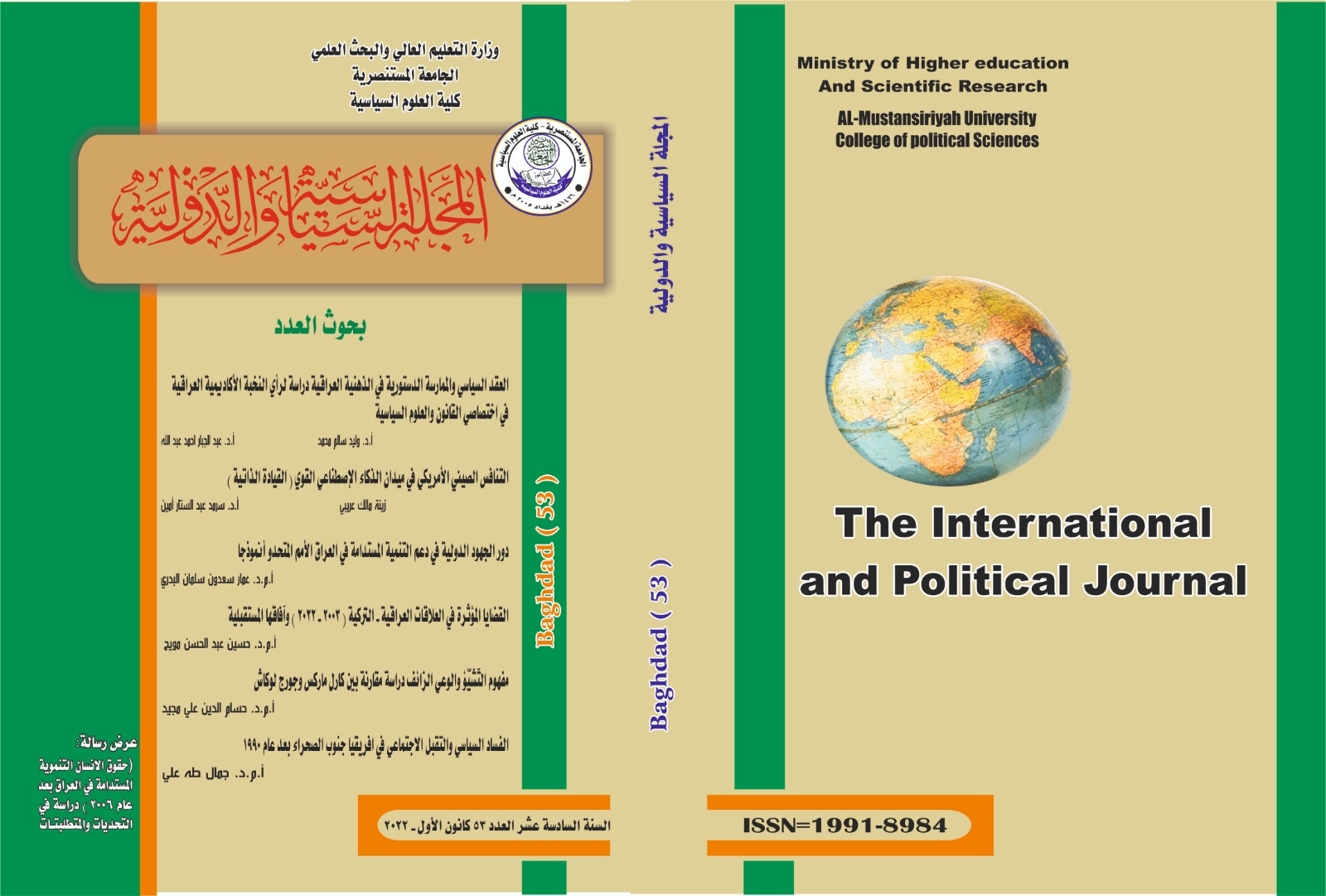
the international and political journal
Abstract
Iranian policy toward Afghanistan is embodied as a complex system where geography interacts with history, interests with regional transformations, within a space where the boundaries between security, influence, and culture overlap. This overlap has produced a pattern of engagement based on reshaping the tools of influence according to the changing environment. Bilateral relations are no longer governed by a fixed logic, but rather by a logic of continuous adaptation to political and security changes in the region.
Within this framework, geopolitical objectives have crystallized into the cornerstone of Iran's role, through the pursuit of establishing an active position within a regional equation characterized by multiple powers and overlapping interests. Alongside this, the economic dimension has emerged as a supporting avenue that strengthens interdependence and creates practical channels of communication between the two sides. Meanwhile, the cultural dimension has taken on a long-term, cumulative character, relying on subtle influence and the reshaping of spaces for social and intellectual interaction.
On the security and military level, Iranian policies have been linked to the logic of protecting its border depth and containing potential threats, adopting more preventative approaches than direct reactions. This reflects the sensitivity of Afghanistan's geographical location in Iranian calculations. With the overlap of these levels, a general picture has emerged of a policy characterized by flexibility and repositioning, operating within a wide range of possibilities, where no single factor overshadows another, but rather all are integrated within a pragmatic vision.
Thus, this trajectory can be understood as a continuous dynamic structure, its tools changing without altering its fundamental goal: maintaining and adapting influence to a highly complex regional environment. This makes Afghanistan a pivotal element in the equation of Iranian balancing within its sphere of influence.
References
Al-Fadhli, Hussein. 2006. Shi‘a in Afghanistan. Beirut: Dar Al-Safwa.
Al-Habouni, Hassan Hamid. 2021. Iranian Policy toward the Arab East 1979–2016. Amman: Dar Al-Academy Publishing and Distribution Company.
Zidan, Ahmad Muwaffaq. 2002. Taliban Afghanistan: The Movement’s Future and State Prospects. Doha: Arab Center for Research.
Hammadi, Dari Sarhan. 2012. Iran’s Policy toward Neighboring States. Cairo: Al-Arabi Publishing and Distribution.
Zaid Allah, Imad Al-Din. 2010. Egyptian Foreign Policy toward Afghanistan 1979–2008. Cairo: Al-Shorouk International Library.
Hamid Shah, Hamidullah. 2025. How Iran Became Taliban’s Closest Friend?. Doha: Al Jazeera Center for Studies.
Saqil, Amin. 2021. Iran and Afghanistan: Shared Interests and Complexities. Doha: Arab Center for Research.
Al-Habouni, Hassan Hamid. 2017. “Motives and Implications of Russian-Iranian Interventions in Afghanistan.” Journal of Iranian Studies, No. 3.
Al-Rahman Al-Afghani, Ijaz. 2007. “Shiite Activity in Afghanistan.” Al-Forum Al-Islami Journal, No. 243.
Al-Khattabi Center. 2022. Blood of Afghan Shiites in the Balance of Wilayat Khorasan. Analytical Report. Riyadh.
Mahdi, Muhammad Mahmoud. 2025. Iranian Presence in Afghanistan: Development, Spread, and Future Outlook. Strategic Studies 210. Abu Dhabi: Emirates Center for Strategic Studies.
Fattah, Alex. 2017. What Are Iran’s Goals in Afghanistan?. Report. Edraak Center for Studies and Consultations.
Talat, Rami. 2010. “Afghanistan: Where International Conflict Begins and Regional Ends.” Al-Forum Al-Islami Journal, No. 279.
Zain, Fadl Al-Hadi. 2024. “Fatemiyoun Brigade in Afghanistan: Fighters Loyal to Iran.” 28/04/2024. https://www.aljazeera.net/politics/2024/4/28/
Na‘ama, Karam. 2021. “Iran and Taliban: Complex Pragmatism, Neither Enemies nor Friends.” 19/08/2021. https://n9.cl/arwag
Al-Haii, Rasul. 2023. “Iran and Afghanistan Water Rights from Helmand River.” 31/07/2023. https://www.aljazeera.net/politics/2023/7/31/
Mohammad Shah, Hamidullah. 2025. “How Did Iran Become Taliban’s Closest Ally?” 09/02/2025. https://www.aljazeera.net/politics/2025/2/9/
Majdi, Sami & Al-Sabbagh, Muhammad. 2017. “How Iran Established Its Presence in Afghanistan.” 10/08/2017. https://n9.cl/arwag
“Iran in Afghanistan: Negotiating with Kabul and Taliban and Arming the Hazaras.” 2021. 03/08/2021. https://n9.cl/2a0h1h
“Scientific Cooperation between Iran and Afghanistan in Shaping Contemporary Islamic Civilization.” 2025. 16/02/2025. https://www.avapress.com/ar/news/307696/
Additional Files
Published
How to Cite
Issue
Section
License

This work is licensed under a Creative Commons Attribution 4.0 International License.
Journal Policies
All articles published in the International and Political Journal are licensed under a Creative Commons Attribution 4.0 International License. This means that the Authors can:
The journal allows reuse and remixing of content in accordance with a Creative Commons license.
Copy and redistribute the material in any medium or format.
Policy of publishing in The International and Political Journal
The journal is committed to the ethics of scientific publishing, and according to the publication ethics report of the journal.
The decision to publish is based on the value of the scientific research, to what extent it meets the conditions of publication approved, the declared policy of the journal, and its specialty.
It is based on the principles of the scientific honesty, and originality of research submitted for publication. It deals with the names of reviewers and their reports with great confidentiality.
The opinions published in the journal reflect the views of the authors, and not necessarily reflect the opinion of the editorial board.
The journal does not adhere to the publication of whatever comes to it. The time and place of publication are subject to technical considerations adopted in the editorial plan of the journal.
The journal does not abide to return the research papers to their owners whether accepted for publication or not.
The researcher is to be provided with the acceptance of publication within about 24 WEEKS. As for publication, the editorial board reserves its right in priority of publishing. The arrangement of the research papers in the same issue is subject to technical standards.
Diversify of publishing papers from solid universities and scientific centers from inside and outside Iraq is preferable.
The journal maintains hard copies and electronic archive of the published issues in addition to the publication of the research papers.
The journal also publishes the issues electronically through the website of the journal, and the official website of the Iraqi academic journals, and makes it possible to download. Thus, documenting the intellectual property of the research papers and publishing them internationally is achieved.
Terms of publication may be modified when necessary with no previous notice.
The researcher obtains a copy of his research paper. If he wishes to buy acopy of the journal, the volume costs ID 10000 from inside Iraq and $8from the outside.
The Editorial Board considers that the researcher who submits his research paper for publication in the journal has already read the terms and conditions of publication and agreed on them.
The journal publishes the research papers of the postgraduate students in special issues for this purpose.
Stages of editing and publishing:
The researcher undertakes that his research has never been published before, and has not been submitted for publication to other sides until the end of the evaluation procedures and the acceptance of publication in the journal.
The research papers submitted for publication are to subjected for preliminary examination by the editorial board to determine their suitability for the journal specialization, its policy and the safety of scientific research procedures, and then to indicate its eligibility for scientific evaluation. The editorial board may apologize for accepting the research all together or require the researcher to amend it in accordance with the journal policy before sending it to editors.
After conducting the scientific evaluation, the research paper returns back to the researcher to make the required amendments within a maximum of two weeks.
A copy of the final research paper is to be submitted to the secretariat of the journal a hard copy and a soft copy on a CD, in both Word and PDF format. The researcher is fully responsible for the typing and linguistic mistakes after submitting the full research paper on a CD.
Plagiarism checker
All research papers are subjected to Turnitin program to uncover plagiarism before being sent to scientific evaluation. The researcher undertakes a written pledge to take the legal and moral responsibility, in the event of the emergence of plagiarism or taking from the efforts of other researchers, without a reference to them. The journal uses appropriate anti-plagiarism software, such as Turnitin to check for plagiarism.
Dealing with Allegations of Research Misconduct
The Journal shall take reasonable and serious steps to identify and prevent the publication of papers where research misconduct has occurred, including plagiarism, citation manipulation, and data falsification/fabrication.
Scientific Evaluation:
Scientific evaluation strengthens the research paper submitted to the journal and helps to take the appropriate decision by the editorial board to publish it. It also benefits the researchers to improve and correct their research papers.
The research paper is sent to three evaluators in the same specialty to evaluate