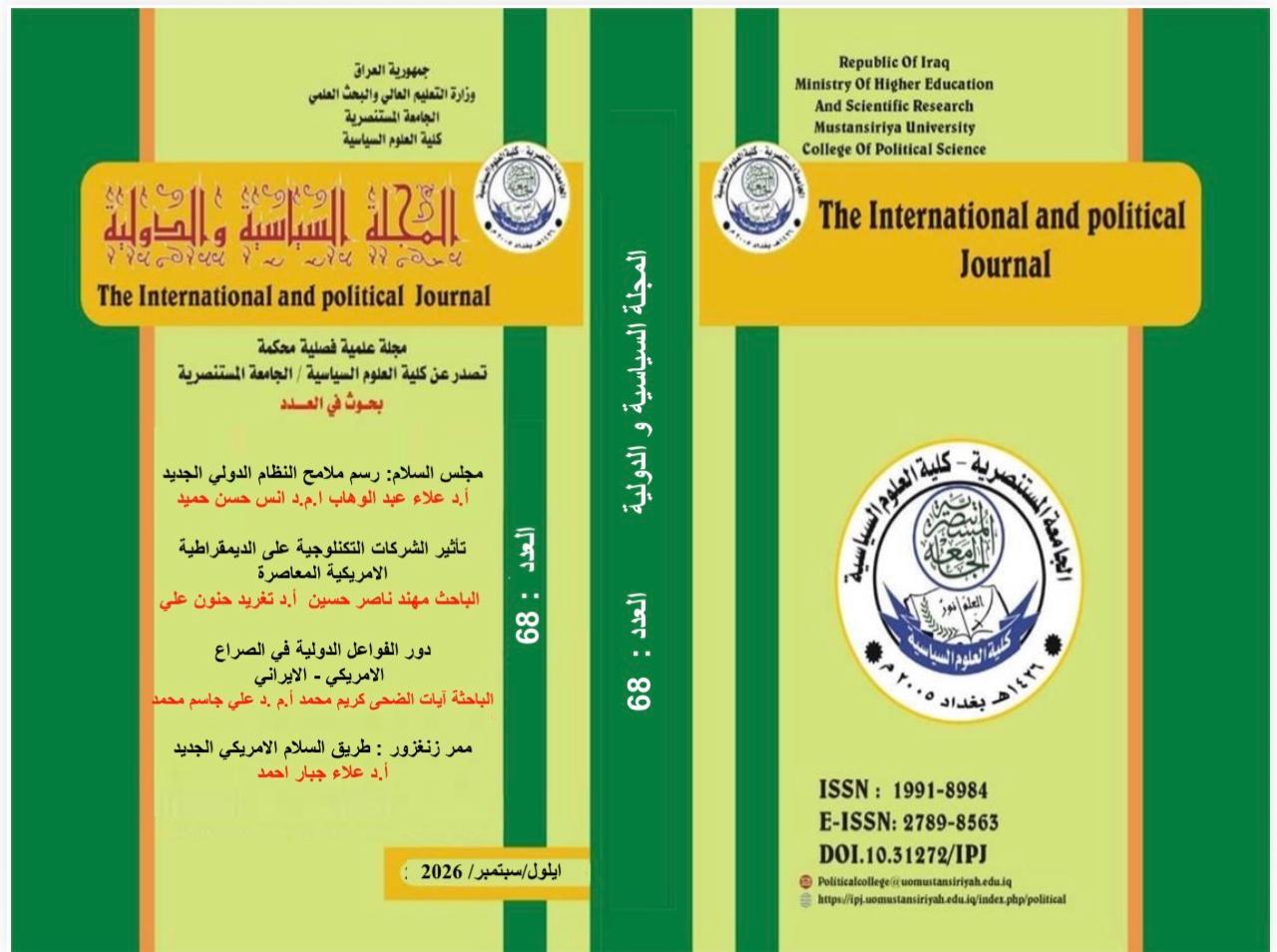
The Role of International Actors in the US–Iran Conflict
the international and political journal
Keywords:
US–Iran conflict, international actors, mediation, regional security, geopolitical balance.Abstract
This study examines the role of international actors in the U.S.–Iranian conflict, as one of the most prominent geopolitical disputes, which has transcended its bilateral nature to encompass complex international security and economic dimensions. The study aims to analyze the interaction patterns of global powers and identify the directions of their positions—ranging from neutrality and mediation to support or opposition—with a specific focus on the period of the second Trump administration leading up to the direct military confrontation in 2026, and the subsequent international mediation initiatives.
The study adopts an inductive method through its descriptive and analytical approaches, by tracking the positions of countries and influential powers and interpreting their strategic and political motives. The findings reveal that the international stance was not unified; rather, it split into a camp opposing the war that calls for de-escalation and diplomacy while providing technological and intelligence cover to Iran, with China and Russia at the forefront of this camp. On the other hand, a pro-U.S. camp provides political, military, and intelligence support, spearheaded by Britain and Western nations. This international division is highlighted in the advanced technical support provided by China and Russia to Iran through supplying it with satellite imagery and artificial intelligence applications for target identification, in contrast to the formation of an Atlantic front comprising the "Five Eyes" alliance and Ukraine to enhance deterrence capabilities and protect Western navigation. The significance of these findings highlights that the conflict is no longer bilateral, but has rather become a complex network of international interactions that contribute to reshaping the international system and its inevitable link to energy security and global shipping lanes.
Keywords: US–Iran conflict, international actors,
References
Atlantic Council, 2026. Experts react: The US and Israel just unleashed a major attack on Iran. What’s next?. https://www.atlanticcouncil.org/dispatches/experts-react-the-us-and-israel-just-unleashed-a-major-attack-on-iran-whats-next/
Barak Ravid, Vance meets Qatari mediator as U.S. awaits peace plan response, May 8, 2026, https://www.axios.com/2026/05/08/vance-qatar-mediator-iran-war
Dana Stroul, A Return to Maximum Pressure: Comprehensively Countering the Iranian Regime’s Malign Activities, April 1, 2025, https://www.washingtoninstitute.org/policy-analysis/return-maximum-pressure-comprehensively-countering-iranian-regimes-malign
Fatma Khaled, As Iran’s other proxy groups join war, Houthi rebels in Yemen hold back, for now, March 15, 2026, https://www.timesofisrael.com/as-iran-other-proxy-groups-join-war-houthi-rebels-in-yemen-hold-back-for-now
Hasan Alhasan and Others, Wartime Support to Iran: Implications for the Middle East and Beyond, April 24, 2026, https://www.washingtoninstitute.org/policy-analysis/wartime-support-iran-implications-middle-east-and-beyond
Jon B. Alterman and Ali Vaez, How China and Russia Can Exploit the Iran War and How America Can Avoid Playing into Their Hands, Foreign Affairs, April 23, 2026.
Joseph Rachman, Prabowo’s Peacemaker Campaign Now Extends to Iran, March 3, 2026, https://foreignpolicy.com/2026/03/03/prabowo-indonesia-southeast-asia-iran-strikes/
Kim Barker, Ukraine Helps U.S. Bases in the Mideast With Stopping Drones, March 9, 2026, https://www.nytimes.com/2026/03/09/world/middleeast/ukraine-shahed-drone-middle-east.html
Natasha Bertrand and Others, Russia is aiding Iran’s war effort by providing intel on U.S. military targets, March 7, 2026, https://edition.cnn.com/2026/03/06/politics/russia-aiding-iran-targeting
Philip Loft, Israel/US-Iran conflict 2026: Background and UK response, House of Commons Library, April 24, 2026.
Prabowo offers to mediate between Iran and US, The Jakarta Post, March 1, 2026, https://www.thejakartapost.com/world/2026/03/01/prabowo-offers-to-mediate-between-iran-and-us.html
Salman Masood, Pakistan Walks a Tightrope on Iran, Foreign Policy, April 10, 2026.
Seyed Hossein Mousavian, America and Iran’s Long Road to Peace, Foreign Policy, April 17, 2026.
Souhire Medini, Encouraging European Military Efforts to Reopen the Strait of Hormuz, April 24, 2026, https://www.washingtoninstitute.org/policy-analysis/encouraging-european-military-efforts-reopen-strait-of-hormuz
Tahir Mahmood Azad, Chinese Eyes, Iranian Missiles: Intelligence Cooperation in the US/Israel–Iran War 2026, April 23, 2026, https://irregularwarfare.org/articles/china-iran-intelligence-cooperation-2026-war/
Yoel Guzansky and Ron Tira, The War with Iran from the Perspective of the Gulf States, April 16, 2026, https://www.inss.org.il/publication/gulf-states-war/
Why did Iran hit Kuwait so hard?, Responsible Statecraft, April 29, 2026, https://responsiblestatecraft.org/iran-and-kuwait-war/
Prabowo offers to mediate between Iran and US, Thejakartapost, March 1, 2026, https://www.thejakartapost.com/world/2026/03/01/prabowo-offers-to-mediate-between-iran-and-us.html.
Seyed Hossein Mousavian, America and Iran’s Long Road to Peace, ForeignPolicy, April 17, 2026.
Additional Files
Published
How to Cite
Issue
Section
License

This work is licensed under a Creative Commons Attribution 4.0 International License.
Journal Policies
All articles published in the International and Political Journal are licensed under a Creative Commons Attribution 4.0 International License. This means that the Authors can:
The journal allows reuse and remixing of content in accordance with a Creative Commons license.
Copy and redistribute the material in any medium or format.
Policy of publishing in The International and Political Journal
The journal is committed to the ethics of scientific publishing, and according to the publication ethics report of the journal.
The decision to publish is based on the value of the scientific research, to what extent it meets the conditions of publication approved, the declared policy of the journal, and its specialty.
It is based on the principles of the scientific honesty, and originality of research submitted for publication. It deals with the names of reviewers and their reports with great confidentiality.
The opinions published in the journal reflect the views of the authors, and not necessarily reflect the opinion of the editorial board.
The journal does not adhere to the publication of whatever comes to it. The time and place of publication are subject to technical considerations adopted in the editorial plan of the journal.
The journal does not abide to return the research papers to their owners whether accepted for publication or not.
The researcher is to be provided with the acceptance of publication within about 24 WEEKS. As for publication, the editorial board reserves its right in priority of publishing. The arrangement of the research papers in the same issue is subject to technical standards.
Diversify of publishing papers from solid universities and scientific centers from inside and outside Iraq is preferable.
The journal maintains hard copies and electronic archive of the published issues in addition to the publication of the research papers.
The journal also publishes the issues electronically through the website of the journal, and the official website of the Iraqi academic journals, and makes it possible to download. Thus, documenting the intellectual property of the research papers and publishing them internationally is achieved.
Terms of publication may be modified when necessary with no previous notice.
The researcher obtains a copy of his research paper. If he wishes to buy acopy of the journal, the volume costs ID 10000 from inside Iraq and $8from the outside.
The Editorial Board considers that the researcher who submits his research paper for publication in the journal has already read the terms and conditions of publication and agreed on them.
The journal publishes the research papers of the postgraduate students in special issues for this purpose.
Stages of editing and publishing:
The researcher undertakes that his research has never been published before, and has not been submitted for publication to other sides until the end of the evaluation procedures and the acceptance of publication in the journal.
The research papers submitted for publication are to subjected for preliminary examination by the editorial board to determine their suitability for the journal specialization, its policy and the safety of scientific research procedures, and then to indicate its eligibility for scientific evaluation. The editorial board may apologize for accepting the research all together or require the researcher to amend it in accordance with the journal policy before sending it to editors.
After conducting the scientific evaluation, the research paper returns back to the researcher to make the required amendments within a maximum of two weeks.
A copy of the final research paper is to be submitted to the secretariat of the journal a hard copy and a soft copy on a CD, in both Word and PDF format. The researcher is fully responsible for the typing and linguistic mistakes after submitting the full research paper on a CD.
Plagiarism checker
All research papers are subjected to Turnitin program to uncover plagiarism before being sent to scientific evaluation. The researcher undertakes a written pledge to take the legal and moral responsibility, in the event of the emergence of plagiarism or taking from the efforts of other researchers, without a reference to them. The journal uses appropriate anti-plagiarism software, such as Turnitin to check for plagiarism.
Dealing with Allegations of Research Misconduct
The Journal shall take reasonable and serious steps to identify and prevent the publication of papers where research misconduct has occurred, including plagiarism, citation manipulation, and data falsification/fabrication.
Scientific Evaluation:
Scientific evaluation strengthens the research paper submitted to the journal and helps to take the appropriate decision by the editorial board to publish it. It also benefits the researchers to improve and correct their research papers.
The research paper is sent to three evaluators in the same specialty to evaluate