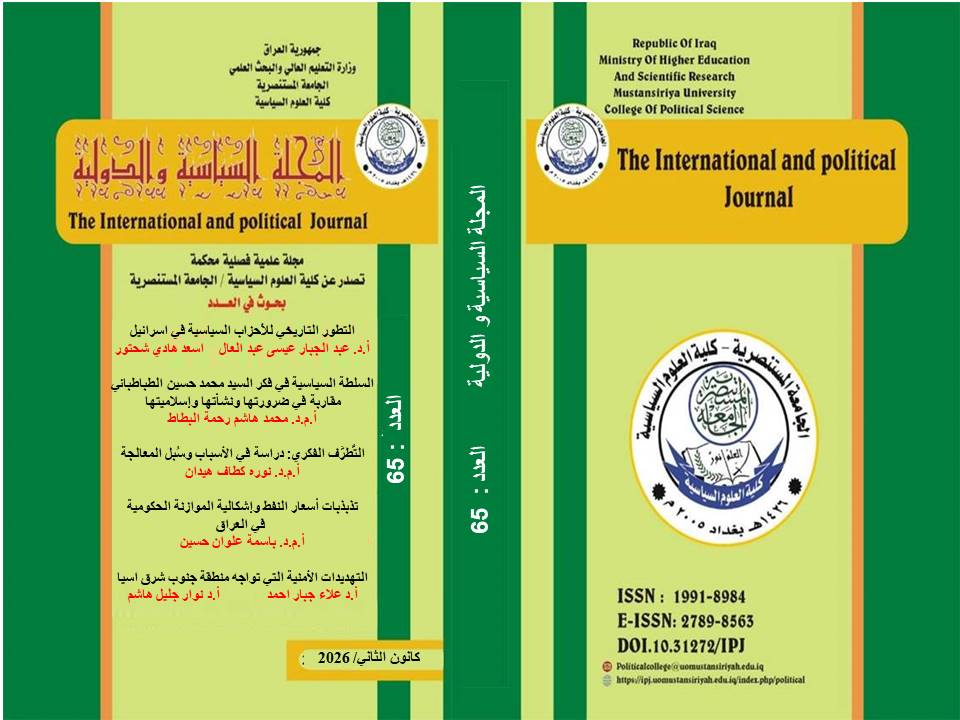
Leadership in foreign policy: Concept and contemporary intellectual approaches
DOI:
https://doi.org/10.31272/ipj.i65.542Keywords:
Smart leadership, political leadership, political leadership theories, artificial intelligence and foreign policyAbstract
Political leadership is an important element in guiding countries and societies through making decisions that impact their lives and futures. Leadership depends on several elements, including strategic vision, personal charisma, and influencing followers by convincing and attracting them. In the context of explaining leadership, theories vary. Some focus on distinctive traits and characteristics, while others adopt the situational or (circumstance) theory that links leadership success to the interactive situation. However, technological developments in the field of artificial intelligence have added a new dimension to this debate. After these systems became capable of processing large amounts of data by analyzing it and proposing immediate solutions, questions were raised about the possibility of these systems replacing human leadership in the future
References
John C Waller, Commentary: The birth of the twin study a commentary on Francis Galton’s The History of Twins, International Journal of Epidemiology, England )Issue 4, Oxford university, 2012). DOI: https://doi.org/10.1093/ije/dys100
Madeleine Wyatt Jo Silvester, Do voters get it right? A test of the ascription-actuality trait theory of leadership with political elites, The Leadership Quarterly, London (Issue 5, Relax group, 2018). DOI: https://doi.org/10.1016/j.leaqua.2018.02.001
Irina Novikova, Trait, Trait Theory, The Encyclopedia of Cross-Cultural Psychology, Edited by: Kenneth D. Keith. (United states, John Wiley & Sons, Inc, 2013). DOI: https://doi.org/10.1002/9781118339893.wbeccp545
Stephen G. walker, Bingard role theory and the dynamics politics: thinking small (New York and London, Routledge, 2025). DOI: https://doi.org/10.4324/9781003532415
Stephen G. walker – Akan Malici – Mark Schafer, Rethinking foreign policy Analysis: states, leaders and behavioral international relations (New York and London, Routledge, 2011) DOI: https://doi.org/10.4324/9780203834862
) Steven J. Campbell, Role Theory, Foreign Policy Advisors, and U.S. Foreign Policymaking, International Studies Association 40th Annual Convention, Washington, February 16–20, 1999, https://ciaotest.cc.columbia.edu/isa/cas01/.
Hakim Unver, Artificial Intelligence, Authoritarianism and the Future of Political Systems, Cyber governance and digital democracy, Istanbul (The Centre for Economics and Foreign Policy Studies (EDAM), 2018)
Najla ALmidfa, Artificial Intelligence in Diplomacy: Transforming Global Relations and Negotiations, Trends research and advisory, 25 October 2024, https://trendsresearch.org/insight/artificial-intelligence-in-diplomacy-transforming-global-relations-and-negotiations/.
Abdul-Hussein, Yasser. 2015. Leadership in American Foreign Policy, 1st ed. Iraq: Adnan Publishing House and Library.
Abdul, Riya Saheb. 2020. "Leadership and its Role in the Strategic Performance of the State." Institute Journal. Najaf, Issue 2. Al-Alamein Institute for Graduate Studies.
Al-Kayyali, Abdul-Wahab. 2009. Encyclopedia of Politics, Vol. 4, 5th ed. Lebanon: Arab Encyclopedia for Studies and Publishing.
Al-Aswad, Sadiq. 1990. Political Sociology: Its Foundations and Dimensions. Iraq: Baghdad University Press.
Badawi, Muhammad Taha. 1983. Introduction to International Relations, 3rd ed. Egypt: Modern Egyptian Office.
Al-Nuaimi, Ahmed Nouri. 2011. The Decision-Making Process in Foreign Policy: The United States of America as a Model. 1st ed. Hashemite Kingdom of Jordan: Zahran Publishing and Distribution House.
Al-Tuwaireesh, Musa Muhammad. 2011. The Political Leader in Contemporary History: A Historical and Political Study of Leadership and the Factors of its Emergence. Syria: Safahat House for Studies and Publishing.
Robert, Jeffrey and Alastair Edward. 1999. The Modern Dictionary of Political Analysis. Translated by Samir Abdul Rahim Al-Jalabi. 1st ed. Lebanon: The Arab House for Encyclopedias.
Miller, Marcel. 1986. Sociology of International Relations. Translated by Dr. Hassan Nafaa. 1st ed. Lebanon: Arab Future House.
Brown, Archie. 2015. The Myth of the Strong Leader: Political Leadership in the Modern Era. Translated by Nashwa Maher Karam Allah. Kingdom of Saudi Arabia: Al-Obaikan.
Mahbouba, Qusay. 2012. The Leader Between Politics, Power, and Influence: The Conflict of Concepts and Personalities in Nations, States, and Institutions. 1st ed. Iraq: Legal Library.
Al-Qamash, Abeer Hussein. 2020. "Leadership and Decision-Making Theories." Scientific Journal of the Faculty of Education - Assiut. Issue 12. Faculty of Education: Assiut University.
Saleh, Yousef Habib and Dina Muhammad Jabr. 2023. "Theories Explaining Strategic Leadership." Journal of International Studies. Baghdad. Issue 93. Center for Strategic and International Studies: University of Baghdad.
Mahmoud, Manar Ezz El-Din. 2015. The Foreign Policy Performance of Presidents George Walker Bush and Barack Obama: A Behavioral Study Using the Comparative Approach. Master's Thesis. Iraq - College of Political Science: Al-Mustansiriya University.
Al-Mualla, Jamil Khalil Naama and Muhammad Ahmad Abu Al-Nawaeer. 2022. "The Impact of the American Behavioral School on Political Theory." Journal of Arts of Kufa. Najaf. Issue 53. College of Arts, University of Kufa.
Awad, Abbas Mahmoud. n.d. Leadership and Personality. Beirut: Dar Al-Nahda Al-Arabiya.
Al-Mutairi, Muhammad Badr. 2015. The Role of Political Leadership in Formulating and Implementing Development Policies in the State of Kuwait (2010-2013). Master's Thesis. The Hashemite Kingdom of Jordan. College of Arts and Sciences, Middle East University.
Hassan, Ahmed Sayed. 2015. The Role of Leadership in State Reconstruction (Russia under Putin). Doctoral Dissertation Series. Beirut: Center for Arab Unity Studies.
Boubaker-Osman and Dalila Jarrah. 2022. "The Theoretical Sociological Perspective on the Concept of Modern Leadership." Journal of Human Sciences. Algeria. Issue 1. Faculty of Humanities and Social Sciences, University of Biskra.
Abu Al-Nasr, Medhat Muhammad. 2009. Future Leaders: The New Distinguished Leadership. 2nd ed. Arab Republic of Egypt: Arab Group for Training and Publishing.
Al-Qarni, Bahgat, and Ali El-Din Hilal Desouki. 2016. Foreign Policy Approaches and the Arab States: A Critical Evaluation and an Alternative Framework, from the book Foreign Policy of the Arab States: The Challenge of Globalization. Edited by: Bahgat Al-Qarni and Ali El-Din Hilal Desouki. Translated by Ahmed Mokhtar El-Gamal. 1st ed. Arab Republic of Egypt: National Center for Translation.
Awda, Jihad Abdel-Malik, and Samir Ramzi. 2017. "Role Theory and Foreign Policy Analysis," Scientific Journal of Commercial Research and Studies. Arab Republic of Egypt. Issue 3. Faculty of Commerce and Business Administration/Helwan University.
Al-Azab, Heba Gamal El-Din Mohamed. 2022. "Political Science Between the Impact of Artificial Intelligence Technologies and a Review of the Pillars of Functions of the State Concept and the Structure of the Global System." Journal of the Faculty of Economics and Political Science. Arab Republic of Egypt. Issue 1. Faculty of Economics and Political Science/Cairo University.
Additional Files
Published
How to Cite
Issue
Section
License

This work is licensed under a Creative Commons Attribution 4.0 International License.
Journal Policies
All articles published in the International and Political Journal are licensed under a Creative Commons Attribution 4.0 International License. This means that the Authors can:
The journal allows reuse and remixing of content in accordance with a Creative Commons license.
Copy and redistribute the material in any medium or format.
Policy of publishing in The International and Political Journal
The journal is committed to the ethics of scientific publishing, and according to the publication ethics report of the journal.
The decision to publish is based on the value of the scientific research, to what extent it meets the conditions of publication approved, the declared policy of the journal, and its specialty.
It is based on the principles of the scientific honesty, and originality of research submitted for publication. It deals with the names of reviewers and their reports with great confidentiality.
The opinions published in the journal reflect the views of the authors, and not necessarily reflect the opinion of the editorial board.
The journal does not adhere to the publication of whatever comes to it. The time and place of publication are subject to technical considerations adopted in the editorial plan of the journal.
The journal does not abide to return the research papers to their owners whether accepted for publication or not.
The researcher is to be provided with the acceptance of publication within about 24 WEEKS. As for publication, the editorial board reserves its right in priority of publishing. The arrangement of the research papers in the same issue is subject to technical standards.
Diversify of publishing papers from solid universities and scientific centers from inside and outside Iraq is preferable.
The journal maintains hard copies and electronic archive of the published issues in addition to the publication of the research papers.
The journal also publishes the issues electronically through the website of the journal, and the official website of the Iraqi academic journals, and makes it possible to download. Thus, documenting the intellectual property of the research papers and publishing them internationally is achieved.
Terms of publication may be modified when necessary with no previous notice.
The researcher obtains a copy of his research paper. If he wishes to buy acopy of the journal, the volume costs ID 10000 from inside Iraq and $8from the outside.
The Editorial Board considers that the researcher who submits his research paper for publication in the journal has already read the terms and conditions of publication and agreed on them.
The journal publishes the research papers of the postgraduate students in special issues for this purpose.
Stages of editing and publishing:
The researcher undertakes that his research has never been published before, and has not been submitted for publication to other sides until the end of the evaluation procedures and the acceptance of publication in the journal.
The research papers submitted for publication are to subjected for preliminary examination by the editorial board to determine their suitability for the journal specialization, its policy and the safety of scientific research procedures, and then to indicate its eligibility for scientific evaluation. The editorial board may apologize for accepting the research all together or require the researcher to amend it in accordance with the journal policy before sending it to editors.
After conducting the scientific evaluation, the research paper returns back to the researcher to make the required amendments within a maximum of two weeks.
A copy of the final research paper is to be submitted to the secretariat of the journal a hard copy and a soft copy on a CD, in both Word and PDF format. The researcher is fully responsible for the typing and linguistic mistakes after submitting the full research paper on a CD.
Plagiarism checker
All research papers are subjected to Turnitin program to uncover plagiarism before being sent to scientific evaluation. The researcher undertakes a written pledge to take the legal and moral responsibility, in the event of the emergence of plagiarism or taking from the efforts of other researchers, without a reference to them. The journal uses appropriate anti-plagiarism software, such as Turnitin to check for plagiarism.
Dealing with Allegations of Research Misconduct
The Journal shall take reasonable and serious steps to identify and prevent the publication of papers where research misconduct has occurred, including plagiarism, citation manipulation, and data falsification/fabrication.
Scientific Evaluation:
Scientific evaluation strengthens the research paper submitted to the journal and helps to take the appropriate decision by the editorial board to publish it. It also benefits the researchers to improve and correct their research papers.
The research paper is sent to three evaluators in the same specialty to evaluate