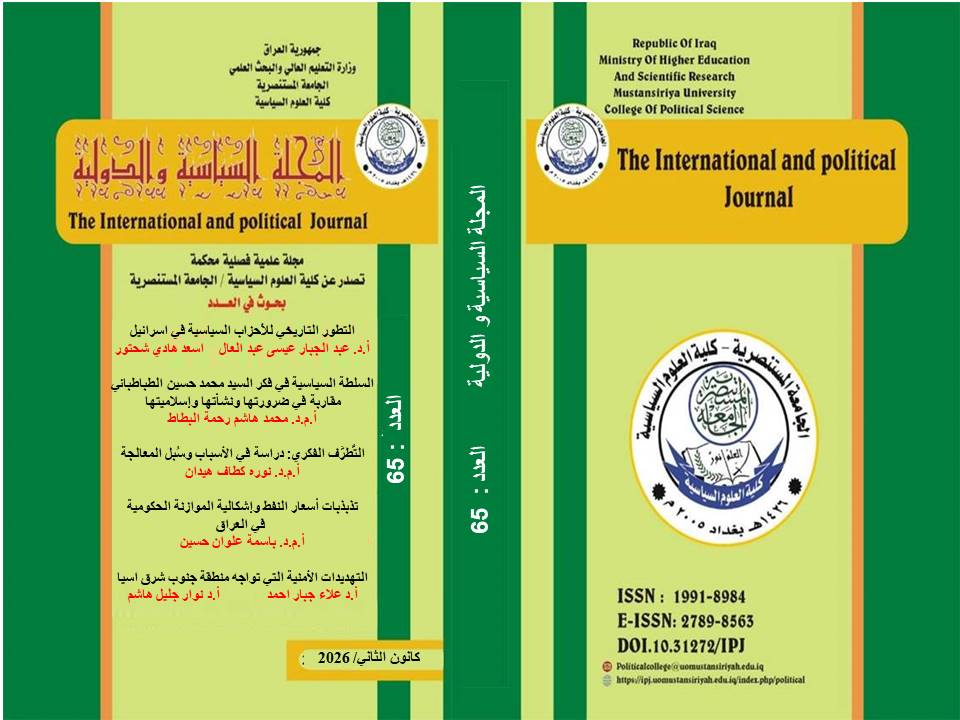
Environmental security in rentier states – oil-producing countries: Iraq as a model)
DOI:
https://doi.org/10.31272/ipj.i65.521Keywords:
Iraq, environmental security, rentier state, oil, sustainable developmentAbstract
This research discusses the issue of environmental security in a rentier state, specifically the case of Iraq, which relies on oil production for national income. The nature of this type of production and its environmental impact are analyzed, and the challenges hindering its effectiveness are identified. These challenges have led to environmental problems at all levels, making Iraq one of the countries most affected by environmental depletion, thus requiring urgent solutions. The economic and social repercussions that Iraq might face if oil production were altered or reduced are outlined, given the economy's complete dependence on this revenue. The research also examines the most important measures taken by the government to mitigate environmental degradation. These measures have ranged from policies addressing environmental degradation to adopting more sustainable production methods to achieve ecological balance. However, these measures have faced numerous challenges at both the legislative and implementation levels due to a lack of expertise in this field. Finally, the research proposes several suggestions to strengthen environmental security.
References
Bezpalova, O., Onopriienko, S., Tarasov, S., Zavalna, Z., & Starynskyi, M. (2020). State Environmental Security in National and Globalization Aspects . Journal of Security and Sustainability Issues, 9. DOI: https://doi.org/10.9770/jssi.2020.9.3(6)
Ruth N. Huil et,al., (2009). strategies to Environ mental security in transition countries, springer sic, Dordrecht, Netherlands, 2009.
Mahdavy, Hussein (2014) The patterns and problems of economic development in rentier states: The case of Iran, in Michael A. Cook (ed.), Studies in the Economic History of the Middle East: From the Rise of Islam to the Present Day, Routledg .
Malek, Adel, (2017). Rethinking the Rentier cure, in Luciani, Giacomo (Ed) : Combining economic and political development: The experience of MENA, International Development Policy, No. 7, , Brill. DOI: https://doi.org/10.1163/9789004336452_004
Andrew G. Bery & Jonathan D. Ostry (2107) inequality and unsustainable Growth: two sides of the Sam coin, journal policy Corner, vol 65.
Li-chen Sim, (2020). low carbon energy in the Golf upending the rentier state, journal Energy research and social seance, vol 70. DOI: https://doi.org/10.1016/j.erss.2020.101752
Alkasser, Mohammed. K. (2021). air pollution in Iraq sources and effects, first International virtual conference on environment and natural resources, earth and environment journal. DOI: https://doi.org/10.1088/1755-1315/790/1/012014
Mustafa Riyadh Matnnaand and other, (2025). oil pollution and its impact on the Environment in Iraq, American journal of botany and bioengineering, vol 2, issue
Additional Files
Published
How to Cite
Issue
Section
License

This work is licensed under a Creative Commons Attribution 4.0 International License.
Journal Policies
All articles published in the International and Political Journal are licensed under a Creative Commons Attribution 4.0 International License. This means that the Authors can:
The journal allows reuse and remixing of content in accordance with a Creative Commons license.
Copy and redistribute the material in any medium or format.
Policy of publishing in The International and Political Journal
The journal is committed to the ethics of scientific publishing, and according to the publication ethics report of the journal.
The decision to publish is based on the value of the scientific research, to what extent it meets the conditions of publication approved, the declared policy of the journal, and its specialty.
It is based on the principles of the scientific honesty, and originality of research submitted for publication. It deals with the names of reviewers and their reports with great confidentiality.
The opinions published in the journal reflect the views of the authors, and not necessarily reflect the opinion of the editorial board.
The journal does not adhere to the publication of whatever comes to it. The time and place of publication are subject to technical considerations adopted in the editorial plan of the journal.
The journal does not abide to return the research papers to their owners whether accepted for publication or not.
The researcher is to be provided with the acceptance of publication within about 24 WEEKS. As for publication, the editorial board reserves its right in priority of publishing. The arrangement of the research papers in the same issue is subject to technical standards.
Diversify of publishing papers from solid universities and scientific centers from inside and outside Iraq is preferable.
The journal maintains hard copies and electronic archive of the published issues in addition to the publication of the research papers.
The journal also publishes the issues electronically through the website of the journal, and the official website of the Iraqi academic journals, and makes it possible to download. Thus, documenting the intellectual property of the research papers and publishing them internationally is achieved.
Terms of publication may be modified when necessary with no previous notice.
The researcher obtains a copy of his research paper. If he wishes to buy acopy of the journal, the volume costs ID 10000 from inside Iraq and $8from the outside.
The Editorial Board considers that the researcher who submits his research paper for publication in the journal has already read the terms and conditions of publication and agreed on them.
The journal publishes the research papers of the postgraduate students in special issues for this purpose.
Stages of editing and publishing:
The researcher undertakes that his research has never been published before, and has not been submitted for publication to other sides until the end of the evaluation procedures and the acceptance of publication in the journal.
The research papers submitted for publication are to subjected for preliminary examination by the editorial board to determine their suitability for the journal specialization, its policy and the safety of scientific research procedures, and then to indicate its eligibility for scientific evaluation. The editorial board may apologize for accepting the research all together or require the researcher to amend it in accordance with the journal policy before sending it to editors.
After conducting the scientific evaluation, the research paper returns back to the researcher to make the required amendments within a maximum of two weeks.
A copy of the final research paper is to be submitted to the secretariat of the journal a hard copy and a soft copy on a CD, in both Word and PDF format. The researcher is fully responsible for the typing and linguistic mistakes after submitting the full research paper on a CD.
Plagiarism checker
All research papers are subjected to Turnitin program to uncover plagiarism before being sent to scientific evaluation. The researcher undertakes a written pledge to take the legal and moral responsibility, in the event of the emergence of plagiarism or taking from the efforts of other researchers, without a reference to them. The journal uses appropriate anti-plagiarism software, such as Turnitin to check for plagiarism.
Dealing with Allegations of Research Misconduct
The Journal shall take reasonable and serious steps to identify and prevent the publication of papers where research misconduct has occurred, including plagiarism, citation manipulation, and data falsification/fabrication.
Scientific Evaluation:
Scientific evaluation strengthens the research paper submitted to the journal and helps to take the appropriate decision by the editorial board to publish it. It also benefits the researchers to improve and correct their research papers.
The research paper is sent to three evaluators in the same specialty to evaluate