Intellectual extremism: A study of its causes and methods of treatment
DOI:
https://doi.org/10.31272/ipj.i65.515Abstract
The concept of intellectual extremism is one of the concepts that is difficult to define or generalize about. This is because extremism is generally linked to many political, religious, social, and psychological variables. This is in addition to the confusion between the concept of extremism and many other concepts such as violence, fanaticism, and terrorism, which are embodied in the massive crises facing contemporary humanity. Because of the destruction and devastation that it causes, and the corruption and devastation of minds that results from it, since the phenomenon of intellectual extremism is one of the basic phenomena and issues that many contemporary societies, especially Arab and Islamic ones, are concerned with. It is a daily life issue whose bridges extend into the structural formation of ideas and ideological ideals accepted in society. Extremist thought, like any social cognitive system, Is affected by and influences other phenomena that are largely linked to historical, political, religious, social, economic and other circumstances to which society is exposed, like any social cognitive phenomenon, must be addressed.
References
Al-Mu'tazili, Ibn Abi Hadid. 1961. Commentary on Nahj al-Balaghah. Edited by Muhammad Abu al-Fadl Ibrahim. Vol. 10. Beirut: Dar Ihya' al-Kutub al-'Arabiyyah.
Al-Nawawi, Abu Zakariya. 1996. Al-Nawawi's Commentary on Sahih Muslim. Vol. 16. Dar al-Khair.
Abu al-Rus, Ahmad. 2001. Terrorism, Extremism, and Violence in Arab Countries. Alexandria: Modern University Office.
Muhammad, Ahmad Bakr Qutb, and Ahmad Muhyi Khalaf Saqr. 2021. "Thinking Styles and Attitudes Towards Social Extremism Among a Sample of University Students (A Field Study)." Journal of Educational and Social Studies. Helwan University - Faculty of Education.
Siraj al-Din, Ismail. 2015. The Challenge: A Cultural Vision for Confronting Extremism and Violence. Cairo: The Egyptian General Book Organization.
Ja'fari, Amal. 2020. "Religious Extremism and Social Media: A Reading of Contexts and Dimensions, with ISIS as a Model." Journal of Humanities, University of Oum El Bouaghi. Issue 1.
Boulaouali, Tidjani. n.d. Extremism and the Battle of Terminology. Morocco: Believers Without Borders Foundation.
Hassan, Shaimaa Mohamed Mahmoud. 2018. "The Strategy of Spreading Extremism and its Impact on Egypt's Regional Role." Journal of Political Science. Issue 56. College of Political Science, University of Baghdad.
Al-Rawas, Anwar bin Mohammed, et al. 2015. The Impact of New Media on Socialization (A Field Study on a Sample of School Students in the Sultanate of Oman). College of Arts and Social Sciences, Sultan Qaboos University, Sultanate of Oman.
Lakhmissi, Jbeiri and Belayali Mohieddine. 2020. The Importance of the Intellectual Factor in the Strategies of Maghreb Countries to Combat Violent Extremism. Unpublished Master's Thesis. Larbi Tebessi University, Faculty of Law and Political Science.
Al-Maayta, Hamza. 2020. "Terrorism and Intellectual Extremism (Concept, Motive, and Ways of Confrontation)." Arab Journal of Scientific Publishing, Issue 23, Hashemite Kingdom of Jordan.
Al-Bayati, Khaled Abdel Ghaffar. 2018. Extremism and National Politics. Al-Nahrain Center for Strategic Studies, Department of Violent Extremism Studies. Available at: http://www.alnahrain.iq
Tarban, Khaled Mohammed. 2018. "The Role of Institutions Community-Based Action in Combating Intellectual Extremism. Al-Quds Open University Journal for Research and Studies. Issue 44, Part 1. Al-Quds University.
Bayman, Daniel. 2021. Al-Qaeda, the Islamic State, and the Global Jihad Movement: What Everyone Needs to Know. Translated by: Al-Rafidain Center for Dialogue. 1st Edition. Al-Rafidain Center for Dialogue.
Fatima, Dahmani, and Dahmani Muhammad. 2022. "Media Literacy and Empowering Adolescents to Confront Intellectual Extremism Through Multimedia Communication." Al-Risala Journal for Media Studies. Issue 4. Larbi Tebessi University - Tebessa, Faculty of Humanities and Social Sciences.
Al-Badayneh, Dhiab, and Khawla Al-Hassan. 2017. "Towards an Integration of Twelve Theoretical Models in Explaining Extremism: The General Model of Extremism." Studies and Research Journal. Issue 26. Jordan: Ibn Khaldun Center for Studies and Research.
Al-Mubarak, Rashid 2006. Extremism: A Global Perspective. 1st ed. Damascus: Dar al-Qalam.
Tantawi, Ramadan Abdel Hamid Muhammad. 2016. "The Causes of the Phenomenon of Extremism Among University Students and Methods of Reducing It from Their Perspective: A Field Study." Journal of the Faculty of Education, Damietta University. Issue 71.
Hassan, Saad Muhammad. 2022. "The Impact of Extremism on Political Stability in Iraq After the Events of 2014." Ibn Khaldun Journal for Studies and Research. Issue 4. Palestine: Ibn Arabi Center for Culture and Publishing.
Hamdan, Saeed bin Saeed Nasser and Sayed Jaballah Al-Sayed Abdullah. 1430 AH. The Role of Social Institutions in Achieving Intellectual Security: A Theoretical Vision and Analytical Study. Paper presented at the First National Conference on Intellectual Security.
Aba Al-Khail, Suleiman bin Abdullah. 2011. The Form and Characteristics of Intellectual Extremism Among Some Islamic Groups in the Modern Era. 1st ed. Imam Muhammad ibn Saud Islamic University.
Hamid, Ali Faris and Ali Ahmad Abdul Marzouq. 2020. "Countering Extremism Policies from a Community Security Perspective (Iraq as a Model)." Journal of Political Issues - College of Political Science - Al-Nahrain University, No. 61.
Al-Omari, Ali. 2021. "The Origins of Doctrinal Extremism in Human Thought: A Methodological Approach." Journal of Non-Arabic Speakers. No. 9. Sultan Mehmet Fatih Waqf University in Turkey.
Nukhba, Ghulam Mustafa and Habib Rahman Rezapour. 2021. "Factors of Growth, Extremism, and Continuity in Afghanistan." Journal of Islam and Humanities. Vol. 5. No. 2. Faculty of Arts and Humanities - Seref Hidayatullah Islamic University.
Mahmoud, Ferial Mahmoud Al-Hajj. 2022. "The Influence of Intellectual Extremism on Social Media." According to some psychological variables.” Arab Journal of Security Studies. Issue 1. Naif Arab University for Security Sciences. Kingdom of Saudi Arabia.
Al-Maayta, Qais Salem. 2016. “The Role of Curricula in Developing the Thinking of Sharia Students at the University of Jordan to Combat Extremism (Some Curricula as a Model).” Journal of the Faculty of Education. No. 169.
Abdelkader, Kass and Tayeb Ahmed. 2021. “The Role of Religious Education in Combating Extremism and Confronting Hate Speech.” Journal of Islamic Sciences and Civilization. No. 2. Algeria: Center for Research in Islamic Sciences and Civilization.
A group of researchers. 2017. Encyclopedia of Extremism: Biographies and Ideas of Al-Qaeda, Salafist, and ISIS Figures in the Region and the World. 1st ed. Baghdad: Biladi Center for Strategic Studies and Research.
A group of researchers. 2021. Electronic Extremism: Causes, Manifestations, and Ways of Confrontation. 1st ed. Cairo: Al-Azhar Observatory for Combating Extremism Extremism.
Abu Awaimer, Magdi Abdullah. 2008. Extremism and Violence in Jewish Thought: A Comparative Study. 1st ed. Egypt: Scientific Papers Series (4).
Ahmed, Muhammad Jamil. 222. "Intellectual Extremism and its Impact on Iraqi Society: An Anthropological Study in Baghdad." Al-Farahidi Journal of Arts, Issue 51, College of Arts, Tikrit University.
Al-Ali, Muhammad Abdullah. 2020. The Social and Ethical Responsibility of Educational Institutions in Confronting Extremism and Terrorism: The United Arab Emirates as a Model. Available at: https://trendsresearch.org/ar/expert
Abdul Halim, Muhyiddin. 2001. Social Awareness on Security Issues. A Group of Researchers. Arab Security Media: Its Issues and Problems. Riyadh: Center for Studies and Research.
Al-Azhar Observatory for Combating Extremism. 2025. Forms of Extremism and Terrorism: An Analytical Study. Research and Studies Unit, Al-Azhar Al-Sharif.
Al-Nisaburi, Muslim ibn al-Hajj. 2013. Sahih Muslim. Beirut: Dar Al-Minhaj for Publishing and Distribution
Abdel Fattah, Nabil. 2017. Observations and Suggestions: Educational and Religious Policy and the Prevention of Extremism. Arab Center for Research and Studies. http://www.acrseg.org/41176
Al-Sultani, Nasreen Hamza. 2015. "The Role of Education in Protecting Young Minds from Extremism and Terrorism." Journal of the College of Basic Education for Educational and Human Sciences. University of Babylon - College of Basic Education. No. 23.
Zaghina, Nawal. 2019. "Socialization and its Role in Shaping Individual Identity (In Light of the Challenges of Globalization)." Journal of Social Sciences. No. 32.
Abdullah, Haitham. 2021. Mechanisms for Achieving Harmony Between Combating Extremist Ideology and Terrorism and Respecting Human Rights. Republic of Tunisia: General Directorate of National Security. 40. Khataybeh, Yousef Damen. 2019. "Factors Contributing to the Growth of Extremism in Contemporary Arab Societies: A Sociological Study." Journal of Human and Social Sciences. Al-Balqa Applied University.
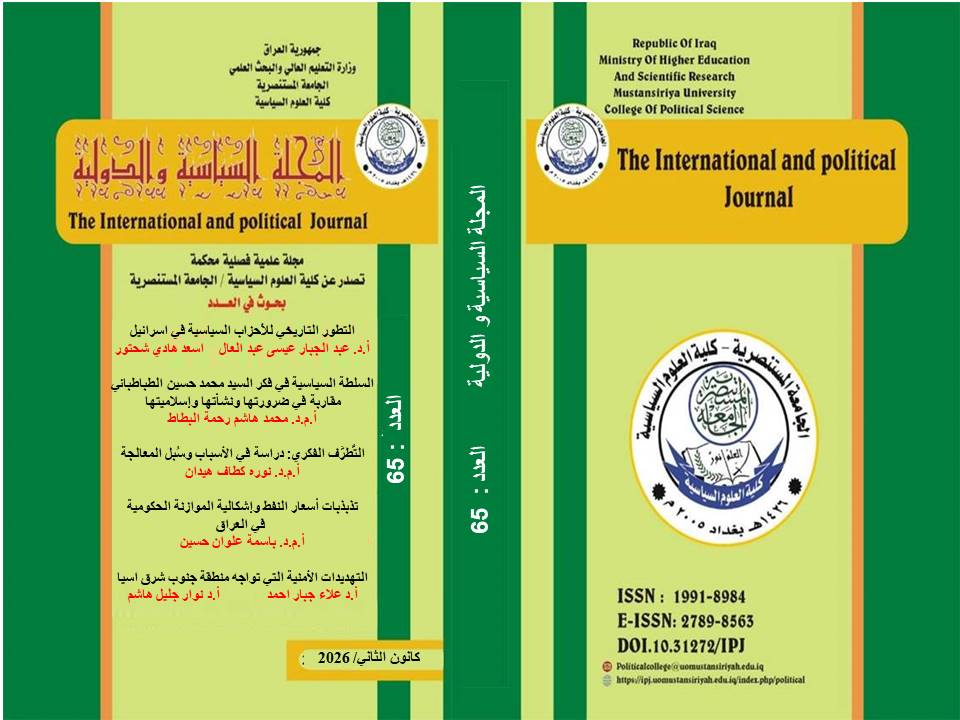
Additional Files
Published
How to Cite
Issue
Section
License

This work is licensed under a Creative Commons Attribution 4.0 International License.
Journal Policies
All articles published in the International and Political Journal are licensed under a Creative Commons Attribution 4.0 International License. This means that the Authors can:
The journal allows reuse and remixing of content in accordance with a Creative Commons license.
Copy and redistribute the material in any medium or format.
Policy of publishing in The International and Political Journal
The journal is committed to the ethics of scientific publishing, and according to the publication ethics report of the journal.
The decision to publish is based on the value of the scientific research, to what extent it meets the conditions of publication approved, the declared policy of the journal, and its specialty.
It is based on the principles of the scientific honesty, and originality of research submitted for publication. It deals with the names of reviewers and their reports with great confidentiality.
The opinions published in the journal reflect the views of the authors, and not necessarily reflect the opinion of the editorial board.
The journal does not adhere to the publication of whatever comes to it. The time and place of publication are subject to technical considerations adopted in the editorial plan of the journal.
The journal does not abide to return the research papers to their owners whether accepted for publication or not.
The researcher is to be provided with the acceptance of publication within about 24 WEEKS. As for publication, the editorial board reserves its right in priority of publishing. The arrangement of the research papers in the same issue is subject to technical standards.
Diversify of publishing papers from solid universities and scientific centers from inside and outside Iraq is preferable.
The journal maintains hard copies and electronic archive of the published issues in addition to the publication of the research papers.
The journal also publishes the issues electronically through the website of the journal, and the official website of the Iraqi academic journals, and makes it possible to download. Thus, documenting the intellectual property of the research papers and publishing them internationally is achieved.
Terms of publication may be modified when necessary with no previous notice.
The researcher obtains a copy of his research paper. If he wishes to buy acopy of the journal, the volume costs ID 10000 from inside Iraq and $8from the outside.
The Editorial Board considers that the researcher who submits his research paper for publication in the journal has already read the terms and conditions of publication and agreed on them.
The journal publishes the research papers of the postgraduate students in special issues for this purpose.
Stages of editing and publishing:
The researcher undertakes that his research has never been published before, and has not been submitted for publication to other sides until the end of the evaluation procedures and the acceptance of publication in the journal.
The research papers submitted for publication are to subjected for preliminary examination by the editorial board to determine their suitability for the journal specialization, its policy and the safety of scientific research procedures, and then to indicate its eligibility for scientific evaluation. The editorial board may apologize for accepting the research all together or require the researcher to amend it in accordance with the journal policy before sending it to editors.
After conducting the scientific evaluation, the research paper returns back to the researcher to make the required amendments within a maximum of two weeks.
A copy of the final research paper is to be submitted to the secretariat of the journal a hard copy and a soft copy on a CD, in both Word and PDF format. The researcher is fully responsible for the typing and linguistic mistakes after submitting the full research paper on a CD.
Plagiarism checker
All research papers are subjected to Turnitin program to uncover plagiarism before being sent to scientific evaluation. The researcher undertakes a written pledge to take the legal and moral responsibility, in the event of the emergence of plagiarism or taking from the efforts of other researchers, without a reference to them. The journal uses appropriate anti-plagiarism software, such as Turnitin to check for plagiarism.
Dealing with Allegations of Research Misconduct
The Journal shall take reasonable and serious steps to identify and prevent the publication of papers where research misconduct has occurred, including plagiarism, citation manipulation, and data falsification/fabrication.
Scientific Evaluation:
Scientific evaluation strengthens the research paper submitted to the journal and helps to take the appropriate decision by the editorial board to publish it. It also benefits the researchers to improve and correct their research papers.
The research paper is sent to three evaluators in the same specialty to evaluate