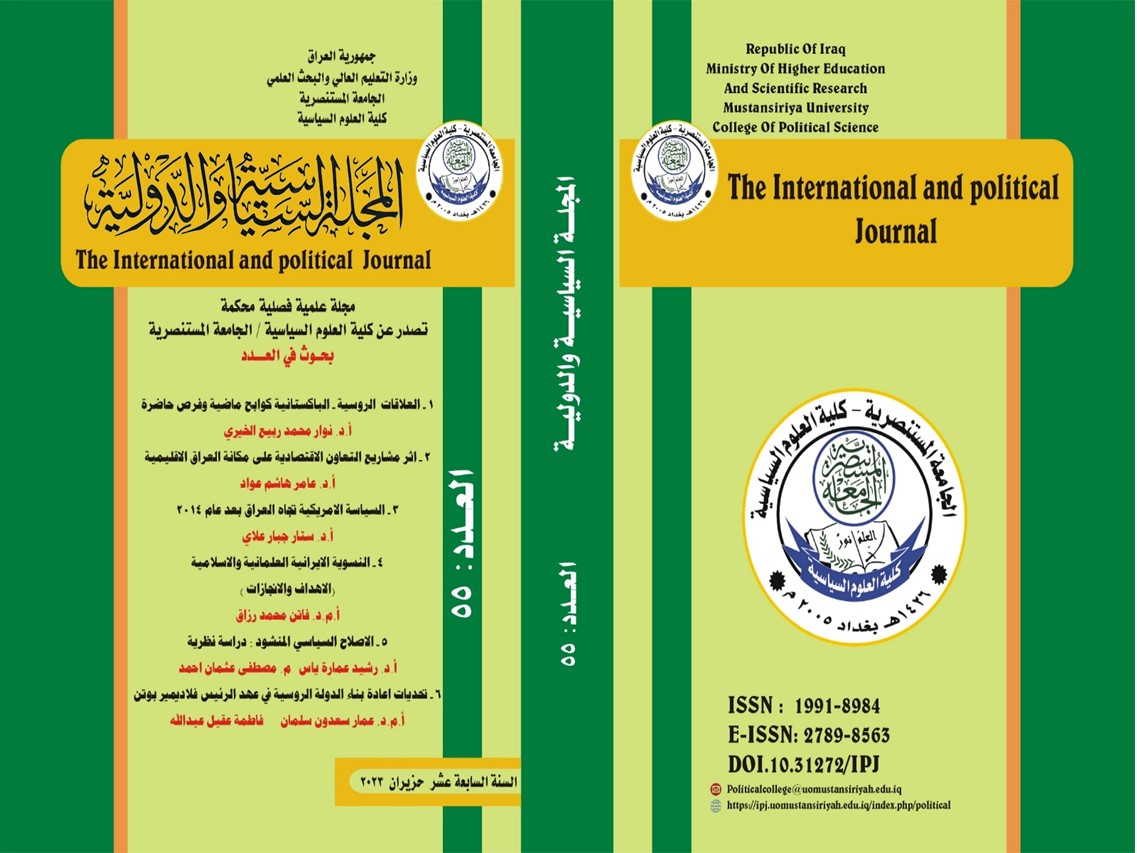
Secular and Islamic Iranian Feminism: Goals and Achievements
DOI:
https://doi.org/10.31272/ipj.i55.504Keywords:
Feminism, Iranian Feminism, Gender, RightsAbstract
The Iranian feminist movement came to express its rejection of the reality based on male discrimination and the treatment of women as second-class citizens. Iranian feminism was influenced by the first Western feminist wave that called for equality between the sexes, the right to work and education, and the issues of hijab and veils, which were considered among the basic issues of Iranian feminism during the Shah’s era, especially after he followed the Westernization regime.
It was natural for Iranian feminism in that era to come up with goals, proposals, and practices similar to Western liberal feminism. However, after the establishment of the Iranian Islamic Revolution in 1979, the scales shifted due to the impact of the revolution, so that Iranian feminism would be affected by its reality, to take the form of traditional and reformist Islamic feminism, approaching the demands of Western movements in the issue of political rights in particular, but rejecting the Shah’s regime and the issues it raised concerning women and the derogation of their rights, especially after the veil was banned in public places, in addition to issues of women’s political and social rights. Therefore, the goals and achievements of the two movements differed due to their influence on internal and external variables. Accordingly, our study represents a comparison of the eras of two different regimes: a secular one and an Islamic one, which was reflected in the nature, forms, goals, and achievements of Iranian feminism.
References
Abu Bakr, Omaima. 2013. alnasawiat walmanzur alaslamiu adafatan jadidat lilmaerifat walaslahi [Feminism and the Islamic Perspective: A New Addition to Knowledge and Reform]. Cairo: Women and Memory Foundation.
The United Nations. 2016. The Human Rights Commission condemns the flogging of 35 young men and women in Iran. May 31. https://news.un.org/ar/story.
Al-Juhani, Malak. 2015. qadaya almar'at fi alkhitab alnisawii almueasiri [Women's Issues in Contemporary Feminist Discourse]. Beirut: Nama Center for Research and Studies.
Al-Haidari, Ibrahim. 2003. alnizam alabawiu washkaliat aljins ean alearabi [The Patriarchal System and the Problematic of Sex for the Arabs]. Beirut: Dar Al Saqi.
Al-Khodari, Anwar Qassem. 2006. alharakat alnasawiat fi alyamin [The Feminist Movement in Yemen]. Saudi Arabia: Dar Resala Al-Bayan. www.al kutubcat.com.
Al-Khamisi, Adeed Jawad. 2015. "Iranian Women Between State Violence and Domestic Violence". 25 6. https://www.ahewar.org/.
Salami, Rand. 2021. almar'at waljindar [Women and Gender]. Baghdad: Leader Library.
Al-Shatti, Nour Al-Duha; Rabo, Anika. 2001. tanzim alnisa' aljamaeat alnisayiyat alrasmiat w ghayr alrasmiat fi alsharq al'awst [Organizing Women, Formal and Informal Women's Groups in the Middle East]. Beirut: Dar Al Mada.
Al-Smadi, Fatima. 2011. “Feminist Implications in Iranian Women’s Cinema.” Scientific Research and Strategic Studies Center for the Middle East. December 21st. https://search.emarefa.net/.
The International Institute for Iranian Studies. 2018." Can the new women's movement in Iran change the status of women?". 05 (04),2018. https://middle-east-online.com.
Andrew Hood. 2012. madkhal alaa alaydiulujiaat alsiyasiat [An Introduction to Political Ideologies], translated by Muhammad Al-Saffar. Cairo: National Center for Translation.
Balody, Michael A. 2018. alnasawiat wahuquq almiraat hawl alealam [Feminism and Women's Rights Around the World], translated by Khaled Kasravi. Cairo: National Center for Translation.
Baali, Hafnawi. 2009. madkhal nazariat alnaqd alnasawiat wama baed alnasawiiti [Introduction to Feminist and Post-Feminist Critical Theory]. Beirut: Arab House for Science.
Bourdieu, Pierre. 2009. alhaymanat aldhukuriat [Male Dominance], translated by Salman Fafarani. Beirut: Center for Arab Unity Studies.
Bayat, Asif. 2014. alhayaat siasat kayf yughirbista' alnaas alsharq al'awsat [Life is Politics: How Simple People Change the Middle East], translated by Ahmed Zayed. Cairo: National Center for Translation.
Jad, Asilah. 2012. alnasawiat bayn aleilmaniat walaslamiat , ean kitab alnasawiat alearabiat ruyat naqdiat [Feminism between Secularism and Islamism, on the book Arab Feminism, A Critical View]. Beirut: Center for Arab Unity Studies.
An-Nahar newspaper. 2016. "In Iran... Will Women Get a Greater Role in Political Life?". 25 2. https://www.annahar.com/arabic/article/.
Jory, Maryam. 2010. "Women's Rights in Iran". March. https://www.maryam-rajavi.com/ar/viewpoints.
Hafez, Fatima. 2018. “The Iranian Feminist Movement: Contexts of Modernization and Islamization.” Journal of Iranian Studies (International Institute for Iranian Studies) No. 2: pp. 70-p. 71.
Hosseini, Nahid. 2018. alharakat aliajtimaeiat aljadidat wa'iiran [New Social Movements and Iran]. Translated by Adel Hayeh. www.ahewar.org.
Haider, Khadr. 2019. “The Concept of Gender.” Al-Istijrab Journal (Issue 16): p. 286.
Rodker, Nargis. 2019. alharakat alnasawiat : mafhumuha asuluha alnazariat watayaaratiha alaijtimaeiat [The Feminist Movement: Its Concept, Its Theoretical Origins, and Social Currents], translated by Heba Zafer. Beirut: The Islamic Center for Strategic Studies.
Sultan, Amer. 2009. "Khomeini's granddaughter to the BBC: We will not give up". June 15th. http://news.bbc.co.uk/.
Saleh, Amani. 2002. [Muslim Women Between Two Centuries Achievements and Challenges]. Beirut: Civilization Center for the Development of Islamic Thought.
Sagheer, Nabil Muhammad; Akdir, Lind ;. 2013. The Problematic of Identity and Equality in Post-Feminism, on the Book of Post-Feminist Discourses: In Exhausting or Modifying Philosophical Projects for Two Research Groups, 1st Edition. Algeria: Difference Publications.
Abbas, Dalal et al. 2009. Women and the Family in the Iranian Constitution and Laws. Beirut: Civilization Center for the Development of Islamic Thought.
Adnan Zamani. 2023. "After the Mahsa uprising.. Where to Iran?". 03 Apr. https://www.alaraby.co.uk/.
Anbari, Saber Gul. 2022. "Iranian women in the hot domestic scene". Oct. 19. https://www.alaraby.co.uk/society.
Awad, Younes. 2012. “alnisawiat aliaslamiat : wuayat tahliliat min waqie aladib almueasiri [Islamic Feminism: An Analytical View of Contemporary Literature].” Al Rozana Journal, Issue Ten: pp. 66-68.
Fort, Ryan. 2004. alnisawiat walmuatinatu [Feminism and Citizenship], translated by Ayman Bakr and Samra Al-Shishakli. Cairo: The National Project for Translation.
Grammy, Aml. 2012. alnasawiat alaslamiat ean kitab alnasawiat alearabiat ruyat naqdiatun [Islamic feminism on the book Arab Feminism Critical View]. Lebanon: Center for Arab Women Studies and the Association of Lebanese Women Researchers.
Kumari, Jayawardena, and ruqyah laughter. 2016. alnasawiat walqawmiat fi alealam althaalithi [Feminism and Nationalism in the Third World]. Damascus: Dar Al-Rahba for publication and distribution.
Mutamask, Reza. 2013. The Islamic Feminist Movement: Facts and Challenges for the Book: A Group of Researchers, Women and Their Cases: Comparative Studies between Feminism and the Islamic Vision, 2nd edition. Beirut: Civilization Center for the Development of Islamic Thought.
A group of researchers. 2009. Political Ideologies. Damascus: The Syrian General Book Organization.
—. 2013. Women's Work: Religious and Social Approaches. Beirut: Civilization Center for the Development of Islamic Thought.
Mahmoud, India, and Shaimaa Tantawy. 2016. nazrat lildirasat alnasawiati [Nazra for Feminist Studies]. Egypt: Creative Commons.
The Emirates Center for Strategic Studies and Research. 2009. Analysts Women are the biggest losers in the Iranian elections. 18 4.
Center for International and Regional Studies. 2015. Social Change in Iran after the Khomeini Era. Qatar: Center for International and Regional Studies.
Islamic Cultural Knowledge Library. 2017. "Women in Khomeini's Thought". Al-Tahra Journal (Issue 28): pp. 9 - p. 11.
Amnesty International. 2018. Amnesty International Annual Report (2017, 2018). Britain: British Library.
— 2019". Iran's compulsory hijab laws are a watch over a woman's life". 28 05. https://www.amnesty.org/.
Mehrizi, Mehdi. 2002. nahw fiqh lilmar'at yuakib alhayata [Towards a jurisprudence for women that keeps pace with life]. Beirut: Dar Al-Hadi for printing, publishing and distribution. Series: Contemporary Islamic Issues.
Middle East. 2023. "Iran is addressing the violation of women's rights by tightening laws to protect them from violence". 10 04. https://middle-east-online.com/.
Hashem, Azza Jalal. 2007. The Political Participation of Iranian Women. United Arab Emirates: Emirates Center for Strategic Studies and Research.
Manal, Omar, and others. 2013. taeziz 'awjuh altaazir min ajil alnuhud bihuquq almar'at fi marhalat ma baed alsiraeat fi alduwal almuslimati. [Enhancing Synergies for the Advancement of Women's Rights in Post-Conflict Phases in Muslim Countries]. United States: Brookings Institution.
Women's Committee documents. 2016. "Female political prisoners and the status of women’s wings in Iranian prisons''. November 25th. https://women.ncr-iran.org/.
Wollsencraft, Mary. 2015. alsajinat alsiyasiaat wawade aliajinhat alnisayiyat fi alsujun al'iiraniati [Defending Women's Rights, translated by Abdullah Fadel and Ali Sarim]. Damascus: Dar Al-Rahba.
Walford, Rick. 2009. Feminist Theory on the Book of Political Ideologies for a Group of Researchers, translated by Abbas Abbas. Syria: The Syrian General Organization for Books.
Wikipedia. 2019. "Iranian Women's Movement". Iran: The Free Encyclopedia.
Additional Files
Published
How to Cite
Issue
Section
License

This work is licensed under a Creative Commons Attribution 4.0 International License.
Journal Policies
All articles published in the International and Political Journal are licensed under a Creative Commons Attribution 4.0 International License. This means that the Authors can:
The journal allows reuse and remixing of content in accordance with a Creative Commons license.
Copy and redistribute the material in any medium or format.
Policy of publishing in The International and Political Journal
The journal is committed to the ethics of scientific publishing, and according to the publication ethics report of the journal.
The decision to publish is based on the value of the scientific research, to what extent it meets the conditions of publication approved, the declared policy of the journal, and its specialty.
It is based on the principles of the scientific honesty, and originality of research submitted for publication. It deals with the names of reviewers and their reports with great confidentiality.
The opinions published in the journal reflect the views of the authors, and not necessarily reflect the opinion of the editorial board.
The journal does not adhere to the publication of whatever comes to it. The time and place of publication are subject to technical considerations adopted in the editorial plan of the journal.
The journal does not abide to return the research papers to their owners whether accepted for publication or not.
The researcher is to be provided with the acceptance of publication within about 24 WEEKS. As for publication, the editorial board reserves its right in priority of publishing. The arrangement of the research papers in the same issue is subject to technical standards.
Diversify of publishing papers from solid universities and scientific centers from inside and outside Iraq is preferable.
The journal maintains hard copies and electronic archive of the published issues in addition to the publication of the research papers.
The journal also publishes the issues electronically through the website of the journal, and the official website of the Iraqi academic journals, and makes it possible to download. Thus, documenting the intellectual property of the research papers and publishing them internationally is achieved.
Terms of publication may be modified when necessary with no previous notice.
The researcher obtains a copy of his research paper. If he wishes to buy acopy of the journal, the volume costs ID 10000 from inside Iraq and $8from the outside.
The Editorial Board considers that the researcher who submits his research paper for publication in the journal has already read the terms and conditions of publication and agreed on them.
The journal publishes the research papers of the postgraduate students in special issues for this purpose.
Stages of editing and publishing:
The researcher undertakes that his research has never been published before, and has not been submitted for publication to other sides until the end of the evaluation procedures and the acceptance of publication in the journal.
The research papers submitted for publication are to subjected for preliminary examination by the editorial board to determine their suitability for the journal specialization, its policy and the safety of scientific research procedures, and then to indicate its eligibility for scientific evaluation. The editorial board may apologize for accepting the research all together or require the researcher to amend it in accordance with the journal policy before sending it to editors.
After conducting the scientific evaluation, the research paper returns back to the researcher to make the required amendments within a maximum of two weeks.
A copy of the final research paper is to be submitted to the secretariat of the journal a hard copy and a soft copy on a CD, in both Word and PDF format. The researcher is fully responsible for the typing and linguistic mistakes after submitting the full research paper on a CD.
Plagiarism checker
All research papers are subjected to Turnitin program to uncover plagiarism before being sent to scientific evaluation. The researcher undertakes a written pledge to take the legal and moral responsibility, in the event of the emergence of plagiarism or taking from the efforts of other researchers, without a reference to them. The journal uses appropriate anti-plagiarism software, such as Turnitin to check for plagiarism.
Dealing with Allegations of Research Misconduct
The Journal shall take reasonable and serious steps to identify and prevent the publication of papers where research misconduct has occurred, including plagiarism, citation manipulation, and data falsification/fabrication.
Scientific Evaluation:
Scientific evaluation strengthens the research paper submitted to the journal and helps to take the appropriate decision by the editorial board to publish it. It also benefits the researchers to improve and correct their research papers.
The research paper is sent to three evaluators in the same specialty to evaluate