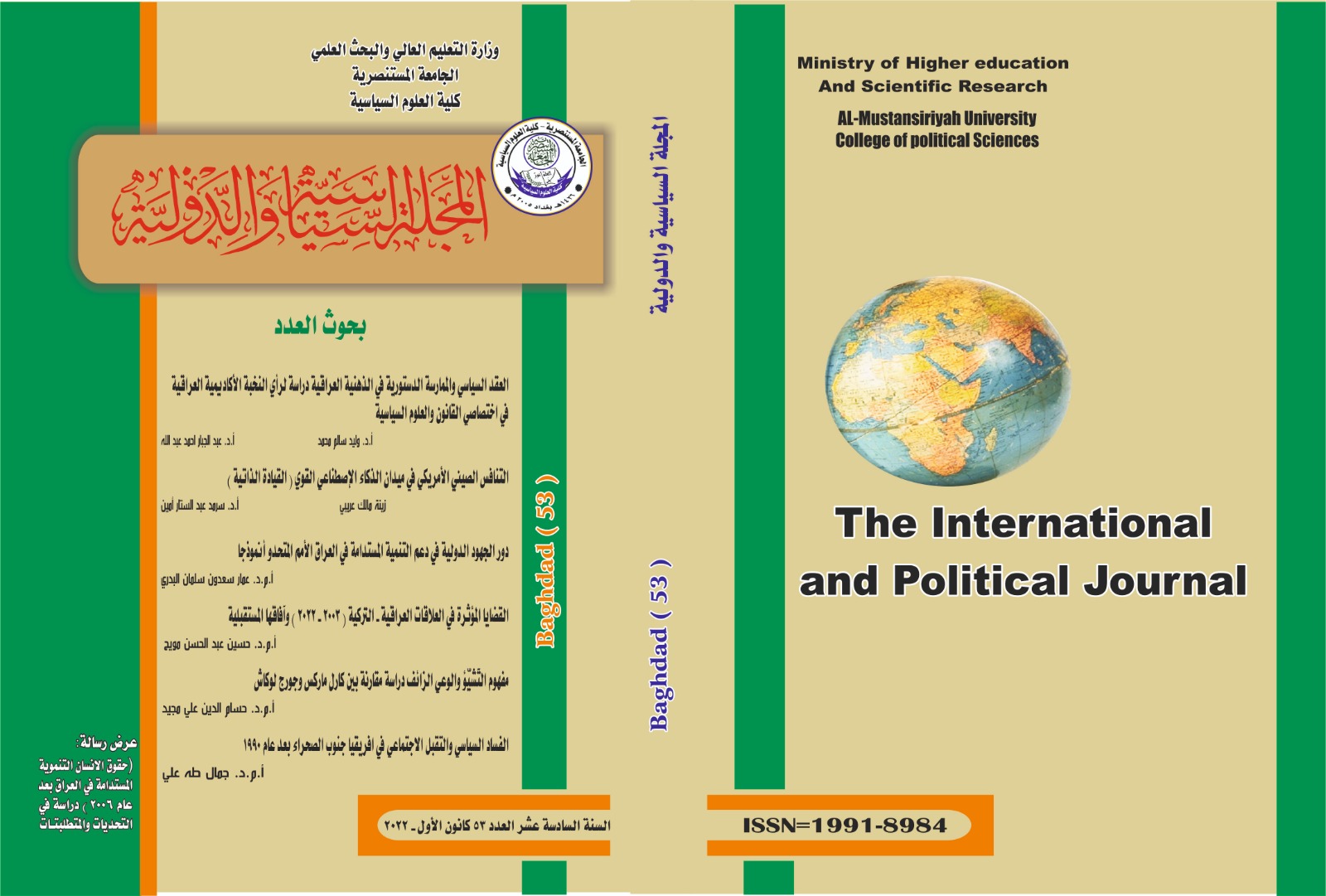
Electoral culture in Iraq and the role of communication media Social in its cognitive restructuring
DOI:
https://doi.org/10.31272/ipj.i64.475Keywords:
electoral culture, social communication, Iraq, cognitive restructuring.Abstract
The important study was devoted to the culture of society and liberalism in the formation and maturation of the culture of good people, especially as it is today illuminated by the foundations of democratic transformation within the framework of theory and practice. The idea of this study was justified in light of the dangerous master phenomenon in the levels of participation of the Iraqi voter, whether in the 2021 elections or in the field of The 2023 governorate elections chose the problem and imposed the hypothesis to reach the results, which appeared to fall below the level of the chosen culture and its social choice was complicated by the actors of social media, and was determined by the axes of the study supported by contemporary public evidence.
References
Wahban, Ahmed. 2003. Political Backwardness: A New Vision for the Political Situation in the Third World, Alexandria: University House.
Baqour, Saber Saeed. 2018. ISIS in Al Jazeera's Vision via Facebook - Discourse and Patterns of Public Awareness. Jordan: Dar Al Khaleej for Press and Publishing.
Ruskin, Michael and others. 2015. Introduction to Political Science. Translated by: Mohamed Safwat Hassan. Cairo: Dar Al Fajr for Publishing and Distribution.
Abd, Mohamed Al Amin Ahmed. 2020. Social Media and Popular Mobilization: Interdependence. Germany: Arab Democratic Center for Strategic, Political and Economic Studies.
Shureih, Mohamed Adel. 2008. Culture in Captivity Towards Dismantling Arab Renaissance Sayings. Beirut: Dar Al Fikr Al Mu'aser.
Othman, Mohamed Adel. 2016. Rooting the Concept of Political Participation. Berlin: Arab Democratic Center.
Willis, Herbert George. 1922. A Brief History of the World. Translated by: Abdel Aziz Tawfiq. Cairo: Egyptian Renaissance Library.
Youssef, Bizid. 2019. The Impact of Social Media on the Democratic Transition in Tunisia 2011-2018. Master's Thesis. University of Martyr Hama Lakhdar. Algeria.
Qawasmiya, Hanan. 2016. Social Media and its Role in Increasing Isolation among University Students - Facebook as a Model. Master's Thesis. University of Arab Tebessi. Algeria.
Ghazi, Zainab Hussein. 2021. Social Media and its Impact on Shaping Political Public Opinion in Iraq after 2014. Master's Thesis. College of Political Science - University of Baghdad.
Sayed, Laith Hadi. 2022. The role of the external factor in building political culture and its impact on the Iraqi political system after 2003. PhD thesis. College of Political Science - University of Baghdad.
Bou Kraa, Muhammad. 2016. The contribution of social media networks in improving the performance of sports journalists at Algerian Radio in M'Sila. Master's thesis. Algeria.
Al-Sanjari, Bushra Daoud and Sinhat Muhammad Izz al-Din. 2019. "The role of social media sites in activating the electoral participation of Iraqi youth". Egyptian Journal of Media Research. Cairo University. Issue (66).
Ali, Khalaf Saleh. 2021. "The future of civil political culture in Iraq". Tikrit Journal of Political Science. Issue (23).
Ibrahim, Samar. 2022. "The role of social media in political crises and wars". Arab Affairs Magazine. Issue (191).
Mahdi, Kazem Ali and Abdul Jabbar Ahmed Abdullah. 2018. "Political culture as a tool for analyzing the experience of administrative decentralization in Iraq". Journal of Political Science. University of Baghdad. Issue (56).
Ayadneh, Muhammad Amin. 2017. "The role of social media in building mental perceptions among individuals about Turkey's reputation". Al-Badr Magazine. University of Algeria. Volume (9). Issue (12).
Jassim, Bahr. How to combat misinformation during elections. On the following electronic link: https://arabfcn.net/blog/2021/09/16/blog-disinformation/?tztc=1
International Mission to Supervise the Iraqi Elections. On the link: https://aceproject.org
United Nations Report - Department of Political Affairs. 2016. On the electronic link: https://department.un.org
Culture in the election campaign. Shafaq News. On the electronic link: https://shafaq.com
O'Connell, Shannon. Social media and campaign organization skills. On the electronic link: https://www.ndi.org
The High Electoral Commission. Department of Media and Mass Communication. On the electronic link: https://www.Newspaper
Al-Shammari, Safad. Do social media affect changing the convictions of the Iraqi voter. On the electronic link: https://alsabaah.iq/54421-.html
Abdul-Hafiz, Tariq. Reading the 2023 provincial council elections. On the electronic link: https://www.alaalem.com
Dirbal, Abdul-Wahhab. Elections and their impact on the culture of society. On the electronic link: https://www.echoroulsonline
Al-Abadi, Ali Murad. 2016. Electoral culture between the influence of parties and the modernity of the movement. On the electronic link: https://kerbalaiss.uolserbala.educid
Bahrain Institute for Political Development. On the electronic link: https://www.hipd.org
Al-Eidani, Muntaser. Elections in Iraq, a reboot in a different way. On the electronic link: https://www.jadaliyya.com/Details/39910
Additional Files
Published
How to Cite
Issue
Section
License

This work is licensed under a Creative Commons Attribution 4.0 International License.
Journal Policies
All articles published in the International and Political Journal are licensed under a Creative Commons Attribution 4.0 International License. This means that the Authors can:
The journal allows reuse and remixing of content in accordance with a Creative Commons license.
Copy and redistribute the material in any medium or format.
Policy of publishing in The International and Political Journal
The journal is committed to the ethics of scientific publishing, and according to the publication ethics report of the journal.
The decision to publish is based on the value of the scientific research, to what extent it meets the conditions of publication approved, the declared policy of the journal, and its specialty.
It is based on the principles of the scientific honesty, and originality of research submitted for publication. It deals with the names of reviewers and their reports with great confidentiality.
The opinions published in the journal reflect the views of the authors, and not necessarily reflect the opinion of the editorial board.
The journal does not adhere to the publication of whatever comes to it. The time and place of publication are subject to technical considerations adopted in the editorial plan of the journal.
The journal does not abide to return the research papers to their owners whether accepted for publication or not.
The researcher is to be provided with the acceptance of publication within about 24 WEEKS. As for publication, the editorial board reserves its right in priority of publishing. The arrangement of the research papers in the same issue is subject to technical standards.
Diversify of publishing papers from solid universities and scientific centers from inside and outside Iraq is preferable.
The journal maintains hard copies and electronic archive of the published issues in addition to the publication of the research papers.
The journal also publishes the issues electronically through the website of the journal, and the official website of the Iraqi academic journals, and makes it possible to download. Thus, documenting the intellectual property of the research papers and publishing them internationally is achieved.
Terms of publication may be modified when necessary with no previous notice.
The researcher obtains a copy of his research paper. If he wishes to buy acopy of the journal, the volume costs ID 10000 from inside Iraq and $8from the outside.
The Editorial Board considers that the researcher who submits his research paper for publication in the journal has already read the terms and conditions of publication and agreed on them.
The journal publishes the research papers of the postgraduate students in special issues for this purpose.
Stages of editing and publishing:
The researcher undertakes that his research has never been published before, and has not been submitted for publication to other sides until the end of the evaluation procedures and the acceptance of publication in the journal.
The research papers submitted for publication are to subjected for preliminary examination by the editorial board to determine their suitability for the journal specialization, its policy and the safety of scientific research procedures, and then to indicate its eligibility for scientific evaluation. The editorial board may apologize for accepting the research all together or require the researcher to amend it in accordance with the journal policy before sending it to editors.
After conducting the scientific evaluation, the research paper returns back to the researcher to make the required amendments within a maximum of two weeks.
A copy of the final research paper is to be submitted to the secretariat of the journal a hard copy and a soft copy on a CD, in both Word and PDF format. The researcher is fully responsible for the typing and linguistic mistakes after submitting the full research paper on a CD.
Plagiarism checker
All research papers are subjected to Turnitin program to uncover plagiarism before being sent to scientific evaluation. The researcher undertakes a written pledge to take the legal and moral responsibility, in the event of the emergence of plagiarism or taking from the efforts of other researchers, without a reference to them. The journal uses appropriate anti-plagiarism software, such as Turnitin to check for plagiarism.
Dealing with Allegations of Research Misconduct
The Journal shall take reasonable and serious steps to identify and prevent the publication of papers where research misconduct has occurred, including plagiarism, citation manipulation, and data falsification/fabrication.
Scientific Evaluation:
Scientific evaluation strengthens the research paper submitted to the journal and helps to take the appropriate decision by the editorial board to publish it. It also benefits the researchers to improve and correct their research papers.
The research paper is sent to three evaluators in the same specialty to evaluate